Showing posts with label peanuts. Show all posts

Sunday, February 14, 2016

Matsaman Curry // Fresh coconut milk beats homemade curry paste any day


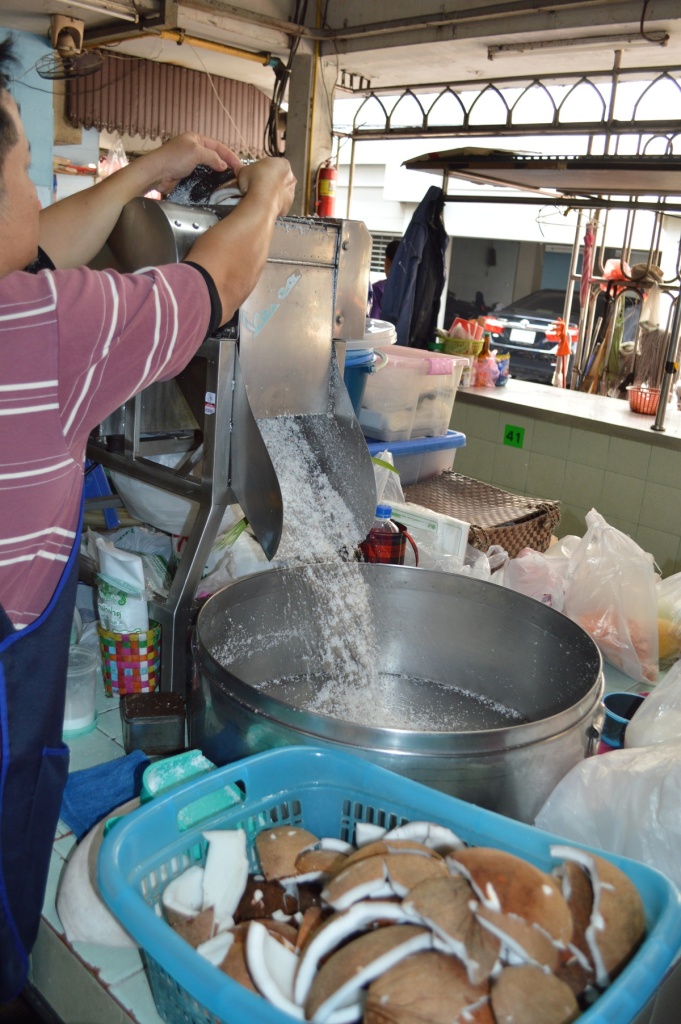
On our trip to Thailand a few years ago, I was captivated by the freshness of the ingredients. The Thai markets are filled with fresh produce and all manner of slaughtered animal parts, which is impressive enough, but then there are the prepared foods - the curry pastes, the sausages, the shrimp chips, and of course, the coconut milk. I had no idea that this was made on a small scale, but after seeing the operation, it made sense - coconut flesh could be shredded quickly, and then a small hydraulic press can crank out a few quarts of fragrant coconut milk every few minutes. We had multiple occasions to taste this fresh coconut milk (and coconut cream, will explain later), and it was starkly different from the thick, somewhat savory canned coconut milk we commonly get in the U.S. Most notably, when you smell homemade coconut milk, it smells like... coconuts! There's no plastic, fatty smell from the preservation of the liquid necessary to get it into cans and across the ocean. The freshly made milk makes no mistake in letting you know what it is, and, as I would soon learn, offers exactly the same unapologetic, coconutty brashness when made back at home with a questionably old coconut. So I watched this process, enthralled by the heavy machinery nestled within the small farmer's market, bound and determined to try replicating this at home with hand tools.


The story wasn't actually that simple. I started out thinking that the magic was all in the paste, with no appreciation for the coconut milk. Coming home armed with curry paste recipes, and having sat on the floor smashing herbs in a mortar and pestle for a few hours, I assumed I was an expert in paste making. But more than a few failed attempts back home led me to realize that those little old Thai ladies sitting around smashing up garlic all day really know what they're doing. Homemade curry paste is truly an art, and I do not have the magic just yet. Maybe it's the freshness of the ingredients, I don't know. All I know is that my pastes are too coarse and lack the depth of the ones made fresh in Thailand, or even the ones from a can here. So after one too many mediocre curries, I broke down conceded defeat, requiring much more practice to this day. Instead, I dug into the process of making homemade coconut milk. Thankfully, the gear required isn't too extensive, but it is somewhat challenging to actually do this, if you use the method I used.

We decided to use the coconut milk as part of a matsaman curry, which we really liked when we made it in Chiang Mai. Matsaman, also written massaman, means "muslim", and isn't actually a Thai word at all - it's a Thai interpretation of the Persian dish, referred to in the 19th century as "mussulman" curry, which is a dated term for Muslim. The analog of this dish is American tex-mex food: it's the native culture's interpretation of what an international dish tastes like, adapted somewhat to the local methods. In this case, the dish borrowed the spices brought to Asia by the Muslim spice traders, including cinnamon, cardamom, cloves, bay leaves, cumin, and star anise, but mixed into a paste and then fried with coconut milk, like so many other Thai dishes. It's said to be favored by westerners because of its more familiar spice palette, but honesty I don't like it any more than a good red (kaeng phet) or green (kaeng khiao wan) curry.


This recipe explores a big hack in the process - how much does homemade curry paste matter? And which is more important, high quality coconut milk, or high quality curry paste. The short answer is both, but the longer answer is that you can get a good curry paste from a pouch, but there is no substitute for homemade coconut milk. Using a commercial paste I brought back with me, the finished dish was so spectacular that I have to question if a mediocre homemade paste is in any way a substitute for a reputable packaged paste. What's more, the fresh coconut milk elevates the dish to a floral, magical level, with the subtle fruity perfume that really takes your mind to the tropics. This doesn't happen with a great curry paste and mediocre coconut milk, by converse. Given this and the other curious additions that make up matsaman curry, I'm going to advocate for skipping the paste pounding step in lieu of making your own coconut milk from now on, so long as you agree to use a decent quality paste. Agreed? Okay, let's move on.

Thursday, November 28, 2013

Yum Woon Sen (Chile Lime Glass Noodles)

My first encounter with chile lime noodles was at a vegan food market, where it was framed as a gluten-free, animal byproduct-free meal.  As I ate it, I thought "this would be much better with some animal byproducts in it."  But all of the recipes I found were somewhat bland, Americanized versions of this dish.

Enter the real deal - yum woon sen, which is a Thai salad using mung bean noodles.  You've probably seen these before - they start off pale white, and when you cook them they turn translucent, earning them the name "glass noodles".  They're fairly easy to find, and not to be mixed up with rice vermicelli, which will cook up white, and though they are the same diameter, that's about all they have in common.  Glass noodles are chewy and have a much more neutral flavor, making them perfect for this dish.  And the Thais don't mess around with the whole animal byproduct thing - they thrown in fried, dried shrimp, and often ground pork (which I didn't add here, to try just the standard dried shrimp version).

In addition to getting to buy two new ingredients I had never purchased before, which is always fun, this dish surprised me by how easily it came together.  You don't really cook anything, in the traditional sense.  You basically just soak the noodles in boiling water, then crisp up the dried shrimp and peanuts, and toss everything together.  I was waiting for the stir-fry step the first time I made it, but it never came.  The end result was very healthy and fresh as a result, so now I see why this dish became popular.


Yum Woon Sen (aka Chile Lime Glass Noodles)
From ThaiTable.com


  • 5-6 sprigs cilantro
  • 1 2 ounce (dry) bundle mung bean noodles (aka glass noodles, clear noodles)
  • 1/4 cup dried shrimp
  • 1 tablespoon fish sauce
  • 1 tablespoon fried garlic
  • 1-2 limes
  • 1/2 sliced onion
  • 1/2 cup peanuts
  • 1/2 teaspoon sugar
  • 3 Thai chili pepper
  • 1 cup cut Chinese Celery, or regular celery if you can't find Chinese


If you can't find the Chinese celery above, just use regular celery.  But do at least keep the tops

This single bundle is all you need for the recipe posted here.  Don't get carried away, it will throw off the balance of ingredients

Rinse your vegetables well, and chop them to the right sizes.  They won't end up being cooked, so it has to be bite-sized and ready to go.

Take one of the 2 oz bundles from the noodle pack, and place in a large bowl with boiling hot water for 6 minutes. Strain the noodles and drain, then pour the noodles into a large mixing bowl and cut them with scissors randomly to make the strands easier to serve and eat.  Cut the Chinese celery into 1 ½ inch pieces. Slice onion, top to bottom to get crescent pieces. Chop cilantro and chili peppers.  If making your own, make the fried garlic by placing 6 cloves of garlic in a microwave-safe bowl and cover with 1-2 tbsp neutral oil, then microwave on high for up to 2 minutes, 30 seconds in 30 second increments until nicely browned and fragrant.

If using raw peanuts, fry peanuts in 1 teaspoon of oil over low to medium low heat until light brown and cooked, about 5-7 minutes. Remove peanuts and set aside. Fry the dried shrimp over medium heat until crispy and brown, about a minute, depending on the size of your shrimp. When the shrimp turns whitish, remove from heat and set aside.

Dry-fry the dried shrimp - this was a new one for me.  I found these in the refrigerated section of the Asian grocery store

Make the sauce / dressing - 1 tablespoon of fish sauce, 5 tablespoons of lime juice, and 1/2 tsp (or less) of sugar.  It should be more sour than salty; you should also take into account how salty the shrimp are. The role of sugar here is to round the flavors.

Add a tablespoon of fried garlic to the noodles and mix them. Fried garlic gives the noodles flavor. Add 5 tablespoons of the dressing to the noodles and mix well, reserving the last tablespoon to add only as necessary. Add the peanuts, dried shrimp, onion, Chinese celery, chili peppers and cilantro to the noodles. Toss well and taste. You may need more dressing, depending on water content of the noodles and the concentrations of your seasonings.

Toss all ingredients to combine, and you're done!  Minimal cooking necessary

Saturday, July 14, 2012

Thai Green Papaya Salad (Som Tam)

If you've never tried it, papaya salad is a refreshing (but spicy) first course served in Thailand.  It's got something for everyone's food allergy, too - peanuts, shrimp, and cilantro.  So be careful who you serve this to.  And don't worry if you can't find shrimp paste, since I didn't feel that it added much to the dish, plus it smells... strange.

The recipe provides a fun exercise in taste testing, wherein you get to adjust at the end for sweetness, saltiness, and tartness using three different ingredients.  So even if you abandoned your dreams of culinary school, you can still practice working out each group of your taste buds and feel like a chef for a fleeting moment.

And if you need even MORE reasons to make this, well, let me tell you about papaya.  Did you know that it is a digestive aid?  That it's high in vitamins B and C, dietary fiber, and other minerals?  That it's being studied as a suppressor of liver cancer, and as a contraceptive?  That it has antifungal properties, and its leaves are used to treat malaria?  Or my favorite bizarre 'fact':

"Harrison Ford was treated for a ruptured disc incurred during filming of Indiana Jones and the Temple of Doom by papain (made from papaya) injections."  -Wikipedia, citing the book Harrison Ford: The Films

This recipe was taken practically verbatim from About.com's Thai food page, which is a really good source of information if you're looking to branch out.

Papaya salad - a good way to wake up your taste buds

Thai Green Papaya Salad (Som Tam)
by Darlene Schmidt

  • 1/2 tsp. shrimp paste (if vegetarian, substitute 1/2 Tbsp. Thai golden mountain sauce OR 1/2 Tbsp. soy sauce)
  • 2 Tbsp. good-tasting oil, such as olive
  • 2 Tbsp. fish sauce OR 2+1/2 Tbsp. soy sauce for vegetarians
  • 3 Tbsp. lime juice
  • 1/2 to 1 Tbsp. liquid honey, to taste
  • 1 small green papaya, OR 1/2 large (your papaya should be very firm, the flesh white to light orange in color)
  • 1/2 cup roasted peanuts, or cashews
  • 1-2 cups bean sprouts
  • 1 to 2 tomatoes, cut into long thin strips, or 1/2 pound cherry tomatoes
  • 1 red chili, minced (seeds removed if you prefer a milder salad)
  • 3 spring onions, sliced into long matchstick-like pieces
  • 1/2 cup fresh basil, roughly chopped if leaves are large
  • handful of fresh cilantro

This is what papaya looks like.  I believe the seeds are black when it's ripe

Most of the remaining ingredients.  The shrimp paste is particularly scary

I used a couple of cherry tomato varieties rather than large tomatoes

Prepare the dressing by mixing together the first five ingredients together in a cup. Make sure shrimp paste (if using) and honey dissolve fully.  Set aside.

Peel the green papaya, then slice it in half and remove all the seeds.  Using the largest grater you have, grate the papaya.  If you have a mandoline, things will be a lot more consistent and will go a lot faster, plus you get the opportunity to get stitches.  Place in a large bowl.

Papaya, after a run through the mandoline.  Note the absence of fingertips from the mandoline blade

Shred the green onions to the same shape as the papaya

Add the sliced tomato, spring onion, chili, bean sprouts, and most of the basil.  Add the dressing, tossing to combine.  Add only as much dressing as you think will be necessary - this makes a bit more than I thought should have been in there, and as a result it became too watery by the end.

Add the peanuts / cashews (I prefer to chop, but you can leave them whole).  Toss again, and taste.  If not sweet enough, add a little more honey.  If not salty enough, add a little more fish sauce.  If too sweet or salty, add more lime juice.  If you prefer it spicier, add more fresh-cut chili or dried crushed chili.

To serve, scoop the salad into individual bowls or onto a serving platter.  Sprinkle with remaining basil leaves plus fresh coriander, and serve immediately.

LinkWithin

Related Posts Plugin for WordPress, Blogger...