Showing posts with label risotto. Show all posts

Monday, June 23, 2014

Lemon and Eggplant Risotto

Another hit from Yotam Ottolenghi's book Plenty, this risotto dish makes me realize how much variety there is to cooking eggplant.  And this was a first for me - cooking the eggplant two ways in same the dish.  The resulting flavor was a bit of smokiness and a bit of sweetness between the eggplant cooking styles, balanced by the tang of lemon and the peppery snap of fresh basil.  Add in the richness of the creamy risotto, butter, Parmesan cheese, and about 4 cups of reduced stock, and it's hard to find something wrong with this one.  At least, so long as you're the diner, not the chef.  That's another story, and I suggest keeping extra wine on hand.

Pay no attention to the fact that we took a perfectly good vegetarian entree and served it with a chicken leg - that was an emergency plan that we didn't end up needing, as this dish stood up incredibly well on its own.  Definitely worth making, although you will have a few steps and need to be careful on quite a number of things to not screw up the finished product.


Lemon and Eggplant Risotto
by Yotam Ottolenghi, from Plenty

  • 2 medium eggplants
  • 1/3 cup extra light olive oil
  • 3 tbsp extra virgin olive oil
  • coarse sea salt
  • 1 medium onion, finely chopped
  • 2 garlic cloves, crushed
  • 7 oz risotto rice (carnaroli or arborio)
  • 1/2 cup dry white wine
  • 3.25 - 3.5 cups hot vegetable stock
  • Grated zest of 1 lemon
  • 2 tbsp lemon juice (from 1 lemon)
  • 1.5 tbsp butter
  • 1/2 cup grated Parmesan (about 2 oz), or other mature, hard cheese
  • black pepper
  • 1/2 cup torn basil leaves


Start by prepping the eggplants - char the heck out of one of them over an open flame, turning just before you burn the house down.  Remove from the heat, cut down the center lengthwise, and scrape out the fleshy goodness inside, discarding the skin.  Coarsely chop this flesh and set aside.  If you were to basically mix in a few spices at this point, as if you were making hummus but ran out of chickpeas and only had a delicious eggplant, you'd have baba ghanoush, FYI.  But that's another recipe, for another time.


Dice the remaining eggplant into 1/2" pieces.  Heat up a heavy (I recommend cast iron) pan, and once hot add the 1/3 cup of light olive oil - light so that it has a higher smoke point and won't scorch during this operation.  Pan-fry the diced raw eggplant in 2 batches, turning a few times to get some good browning going.  Remove to a colander and sprinkle with salt.


In a large risotto-sized pot or pan, heat up the 3 tbsp extra virgin olive oil over medium heat, then saute the onion for a few minutes until translucent.  If it's browning, you're getting too carried away.  Add the garlic and continue to cook for 2-3 more minutes.  Then increase heat to high and add the rice, stirring to toss with oil, for 2-3 more minutes.  Add the wine to deglaze, and cook over high flame for yet another 2-3 minutes until nearly evaporated.  Now the fun begins.

Lower the heat to medium, and add a ladle (about 1/2 - 3/4 cup) of the hot vegetable broth to the rice mixture.  Now stir, you fool - stir for all you're worth.  Never stop stirring.  Stir even until there's almost no broth, and add some more, a ladle at a time.  And then when you think you're done stirring, stir some more.  Because this dish only achieves creamy perfection when you dislodge all of the starchy, gooey deliciousness that is the outer layer of a grain of cooked rice, and knock it into the resulting "sauce" that forms from this disembodied starch.  Keep tasting as you stir, and when the rice is cooked through, stop adding broth.  You may need more than 3.25 cups, you may need less.  This is mostly a factor of how old your rice is, and what temperature you're cooking at.

Coat the rice in oil to get heat to all of the grains evenly

Stir constantly to knock surface starch into the mixture and promote creaminess.  Same ideas as with avgolemono soup.  This is almost done, but only tasting it will tell you if it's finished or not.

To finish the dish, remove the pot from the heat, and stir in the chopped eggplant flesh, lemon zest, lemon juice, and most of the cheese.  I recommend zesting the lemon right into the pot, or else the essential oils from the skin will go flying everywhere but into your food, and it just won't be as good.  Crack in 3/4 tsp salt (if using homemade stock, or maybe skip if using store-bought) and some fresh black pepper to taste.  Sprinkle with the diced eggplant, remaining Parmesan, and the torn basil, and grate some additional lemon zest on if you have any remaining.

Saturday, August 17, 2013

Tomato Sausage Risotto in Portobello Caps

Coming off of my last successful risotto experience, I wanted to try another flavorful risotto recipe.  While I love the consistency, I have the same problem with risotto that I do with pizza - too much starch, not enough diversity of flavor.  So rather than making one of the essential risottos - mushroom, or cheese, or lemon - I went with a slightly different take - a tomato-based risotto, promising a somewhat unconventional experience.

Your average risotto is made by slowly cooking the rice in hot broth as it is stirred, unfolding the starchy web on the outer layer of the rice so that it can dissolve into the cooking liquid.  Chicken broth is very commonly used for this.  But I was intrigued by the idea of using canned tomatoes instead of broth, just for the variety.  It turns out that this is an amazing twist on your average risotto, transforming a meaty, savoury dish into a lighter, more aromatic dish.  The meat still finds its way in by way of some Italian sausage, but it's a different backbone that was eye-opening and delicious.


Tomato and Sausage Risotto
Modified from Martha Stewart Everyday Food


  • 1 can (28 ounces) diced tomatoes in juice
  • 1 tablespoon olive oil
  • 3/4 pound sweet or hot Italian sausage, casings removed
  • 1 small onion, finely chopped
  • Coarse salt and ground pepper
  • 1 cup Arborio or Carnaroli rice
  • 1/2 cup dry white wine, or dry Vermouth
  • 10 leaves basil, chiffonaded
  • 1/2 cup grated Parmesan cheese, plus more for serving (optional)
  • 2 tablespoons butter


In a small saucepan, combine tomatoes (with their juice) and 3 cups water. Bring just to a simmer; keep warm over low heat.

In a medium saucepan, heat oil over medium. Add sausage and onion; season with salt and pepper. Cook, breaking up sausage with a spoon, until sausage is opaque and onion has softened, 3 to 5 minutes.


Add rice; cook, stirring until well coated, 1 to 2 minutes. Add wine; cook, stirring until absorbed, about 1 minute.

Add about 2 cups hot tomato mixture to rice; simmer over medium-low heat, stirring occasionally, until absorbed, 4 to 5 minutes. Continue adding tomato mixture, 1 cup at a time, waiting for one cup to be absorbed before adding the next, stirring occasionally, until rice is creamy and just tender, about 25 minutes total (you may not have to use all the liquid).

Here's the process of risotto, armed with a fancy risotto spoon.  Observe how the rice swells and the liquid becomes thicker in these time history photos, taken at the 3 minute mark, the 20 minute mark, and the 26 minute mark.


Remove pan from heat. Stir in basil, Parmesan, and butter; season with salt and pepper. Why the butter?  Because you're "mounting" your sauce.  You heard me.  It's from the French monter au beurre, meaning "build with butter" and pronounced "mount" by the less classy Americans who heard the phrase.  It's the process of adding a cold fat to a hot liquid and getting it to emulsify at temperatures above where it usually breaks down into milk solids, fat, and water.  Restaurants tend to do this to develop a more velvety, bodied sauce, which you have probably simply called "delicious", "rich", or "OMG".  Also, they tend to put in way too much - websites I scanned just called for 1 tbsp butter per 1/2 cup of sauce, so don't get crazy mopping that stuff up with your bread.

These are the finishing ingredients - they only go in at the very end

Now, stand over your dish... and mount it!

Serve immediately, and sprinkle with additional Parmesan, if desired.  For a classy presentation, grill portobello caps and use them as small serving bowls on your plate, as shown above.  A recipe follows.


Grilled Portobello Caps
by me


  • 2 medium portobello caps
  • 1 tsp coarse dijon mustard
  • 1/2 tbsp red wine vinegar
  • salt and pepper
  • 2 tbsp olive oil
Stir together last four ingredients, and brush onto both sides of mushroom caps.  Cook on a hot grill for 5-6 minutes per side.

Sunday, May 5, 2013

Risotto with Shiitake, Asparagus, and Artichoke

Here's a dish that commemorates springtime - a risotto showcasing asparagus, among other things.  Risotto is that classic Italian dish using a short-grain, high starch rice that is stirred continuously during cooking to loosen the starch and create a thick, flavorful sauce that envelops the whole dish.  The dish is almost always made with Arborio rice, although these days you can find arguably better rice to use, such as Carnaroli.  The process also generally follows a formula - saute some aromatics, coat the rice in some oil, add a liquid while stirring, and then add the remainder of the ingredients once cooked, usually including a cheese of some kind. You can't phone this dish in - you have to stir for all you're worth for the 15-20 minutes that the rice cooks, and you have to pay attention to the doneness level so you don't ruin anything.  Be on your guard, and this will be well worth the effort.


Springtime Risotto of Shiitake, Asparagus, and Artichokes
expanded on from Gourmet, May 2003
  • 5 cups chicken broth (40 fl ounces)
  • 1 cup water
  • 1 pound thin to medium asparagus, trimmed and cut into 1/4 inch thick slices, leaving tips 1 1/2 inches long
  • 1 tablespoon olive oil
  • 1/2 stick (1/4 cup) unsalted butter
  • 3/4 pound fresh shiitake mushrooms, stems discarded and caps cut into 1/4 inch thick slices
  • 2 artichoke hearts, fresh if available, jarred if not
  • 2 shallots, finely chopped
  • 1 1/2 cups Carnaroli or Arborio rice (10 ounces)
  • 1/2 cup dry vermouth
  • 2 ounces finely grated Parmigiano-Reggiano (1 cup)

Shiitakes add a great earthy flavor and meaty consistency to this otherwise meat-free (except the broth) dish

Shallots.  Only way this dish would get better is if I put in flakes of gold.

First, we have to blanch the asparagus - boil to partially cook, then stop the cooking process in ice water.  Usually you just use water to boil, but we can do double duty and start heating up the broth here, which saves a pot.  So bring the broth and water to a boil in a large pot, then add asparagus and cook, uncovered, until crisp-tender, 3 to 4 minutes.  Immediately transfer the asparagus with a slotted spoon to a large bowl of ice water to stop the cooking, reserving the hot broth which you should keep at a simmer.  Drain the asparagus and set aside.


Digitize your asparagus.  Anybody ever see that movie Tron?

Blanch in the broth - cook 3-4 minutes, then shock in ice water.  Now the asparagus is ready to add at the last step, cooked and ready to go.

In another large heavy pot or pan, heat the oil with 1 tablespoon butter over moderately high heat until foam subsides, then saute mushrooms.  You want them nicely browned, so I recommend doing this in two batches, using half of the fat each time.  Don't overcrowd the pan or you will get squishy grey mushrooms!  Stir occasionally, until browned, about 4 minutes.  Season with salt and pepper, then transfer to a bowl.

Brown the mushrooms.  You don't want to see moisture coming out - do this in two batches

The mushrooms came out great, but are easily ruined

In that same pan, cook onion in 2 tablespoons butter over moderate heat, stirring, until softened, about 3 minutes.  Add the rice and cook, stirring, 1 minute.  This will coat the rice grains in oil and begin frying them, which adds flavor.  Add the wine to deglaze and start infusing flavor into the rice, and cook, stirring, until absorbed, about 1 minute.

Add the rice and toss to coat in the oil

Now the fun part - start cooking the rice with the broth.  Ladle in 1 cup of the simmering broth and cook at a strong simmer, stirring, until absorbed, about 2 minutes.  Continue simmering and adding broth, about 1/2 cup at a time, stirring frequently and letting each addition be absorbed before adding next, until rice is just tender and looks creamy, 18 to 20 minutes.  There's going to be a lot of stirring involved.  Now here's the most important point: it's done when the rice is cooked through, not when the broth is gone.  Keep tasting periodically as you get towards the end, and when the rice has just a bit of bite left (called al dente or "to the tooth", like a pasta), you're done.  Save any leftover broth for thinning as needed.

Stir the rice while adding broth

Remove from heat and stir in 1/2 cup cheese, remaining tablespoon butter, and salt and pepper to taste. Gently fold in asparagus, artichokes and mushrooms, then cover pan and let stand for 1 minute.  If desired, thin risotto with some of remaining broth.  Serve immediately with remaining cheese on the side.


Sunday, December 4, 2011

Steel-cut Oat Risotto with Chicken Peppers and Manchego

Have you had steel-cut oats yet?  If not, has someone been bugging you about it?  You should listen to that person, because they're awesome, and people say they're more healthy due to the minimal processing.  Steel-cut oats are more chewy than regular oatmeal, as they are more coarsely cut and served.  They therefore require extra cooking time, much more like a rice or barley.  So naturally, someone thought to use steel-cut oats to replace arborio or carnaroli rice in risotto, with amazing results.

Did you know that replacing you just 3 cups of gravy per day with steel-cut oats will lower your cholesterol?
For the record, a quick search online didn't conclusively prove that there are any nutritional differences between rolled oats and steel-cut oats, as both glycemic index and in nutritional value are almost identical, and I haven't seen anything on the degradation of vitamins caused by steaming and toasting the grains first.  And neither can I find any results showing that steel-cut oats are better for you than arborio rice, with the exception of 4x the dietary fiber and slightly fewer carbs per serving (27 g compared to 36 g in a 1/4 cup).  But let's go back to pretend-land where the health food industry is always right, and where we think that steel-cut oats are another of nature's new panaceas, and move on with this awesome recipe.

I followed this recipe to the letter, with the only exception of using breast meat chicken instead of dark, because that's what I had.  And I went with a 9 month aged Manchego cheese.  Manchego is a deliciously tart sheep's milk cheese with little holes in it, aged similarly to a Parmesan but not nearly as long.  The younger ones are more soft, so I went with a middle of the road aging to cut down on costs.  I think I struck the right balance.

A nice piece of 9 Manchego cheese, about to meet a painful end

Now, we're actually going to do some cooking here - this is risotto, not some slow cooker, easy-bake oven recipe where you barely do anything.  Risotto's not one of those "yes Mr. Telemarketer, I do have a few minutes to talk about my current long distance plan" kind of dishes - you need to be attentive.  In risotto, you add broth a little bit at a time while stirring constantly, helping loosen and dissolve the starches on the surface of the grains into a rich, velvety sauce.  It's the exact opposite of pasta, where you leave the stuff alone while boiling so you don't accidentally knock all of the starch into the boiling water and end up with something the consistency of wadded Wonder Bread afterwards.  Also, you're controlling the cooking amount by adding broth gradually, so you don't end up with an overly runny or dry risotto at the end.  Here, look at this:

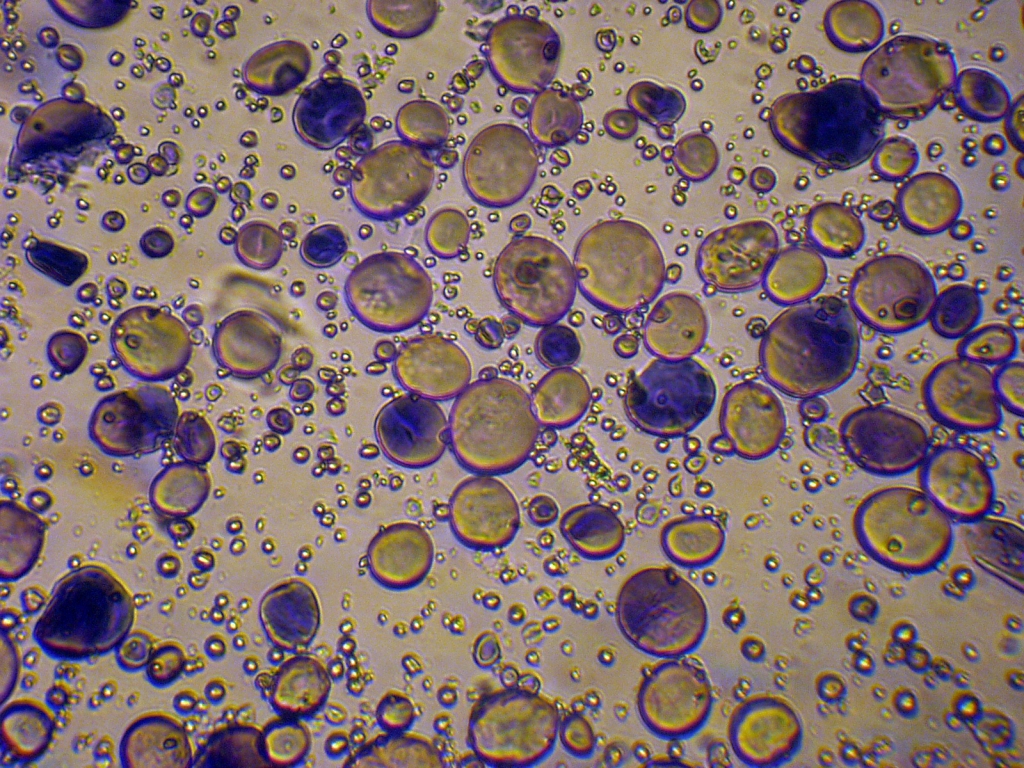
This is a close-up wheat starch molecules from here, stained with iodine so you can see it better.  Picture these cells packed all around things like oats and rice, and essentially forming the entirety of pasta.  When exposed to water, these cells will swell and burst.  And when that happens, smaller particles in the starch (amylose) want to get out, party, and let it all hang out.

So now you've got these amylose bits swimming around, and they're long chains that unravel and get all caught up on each other, like a bunch of christmas light strands in a box despite your best efforts to the contrary.  They form a kind of web that makes for a rich, creamy texture that's, well, it's just great.  So do stir your risotto, and don't stir your pasta.  Shamelessly reproduced from here, by the way.


Steel-Cut Oat Risotto with Chicken, Red Peppers, and Manchego
Cooking Light, March 2005

Yield:  4 servings (serving size: 1 cup)

  • 2 (14-ounce) cans fat-free, less-sodium chicken broth
  • 2 teaspoons olive oil
  • 3/4 cup finely chopped onion
  • 1 large red bell pepper, chopped
  • 1 1/4 cups steel-cut oats
  • 1/2 cup dry white wine
  • 1 cup chopped cooked dark meat chicken
  • 1/2 cup (2 ounces) shredded Manchego cheese
  • 1 teaspoon chopped fresh rosemary
  • 1/2 teaspoon salt

Gather and prepare all of your ingredients.  Bring broth to a simmer in a medium saucepan (do not boil). Keep warm.

The setup.

Here's what I took 'finely chopped' to mean.  Is that diced?  Maybe, but at least its uniform.

Heat oil in a medium sauté pan over medium heat.  Add the onion and bell pepper, and sauté for 5 minutes (don't brown).  Add the oats and cook 2 minutes, stirring constantly.  The goal is to coat the oats in the fat in the pan, and get them toasted slightly.  

Saute vegetables over medium heat, with the heated broth ready and in arm's reach

Toss the grains in the oil before deglazing.  Without supervision, this will burn like a marshmallow over an open fire.

Now to deglaze.  Stir in the white wine and cook for 2 minutes or until nearly absorbed, stirring constantly.  For me, this took about 20 seconds.

Look closely at what's going on here.  That liquid is boiling aggressively, yanking all of the little flavor bits off the pan while you stir.  And as the liquid evaporates, its flavor becomes more concentrated too.  This is deglazing.


Add the broth, 1/2 cup at a time, stirring until each portion of broth is absorbed before adding the next (about 20 minutes in total).  Keep stirring!  Towards the end this may stick, so be careful.

Here's what my risotto looked like when I felt it was done

How do you know when it's done?  Well, a little trick I learned in cooking class was this - taste your food!  Get a spoon, and put some in your mouth.  Does it feel like eating pebbles?  If not, then you might be onto something.  When you feel like it's done, turn off the heat and pull the pan to another burner.  Stir in the chicken, cheese, rosemary, and salt, and serve immediately.

Stir in the cheese, chicken, and rosemary off the heat
Serve with a nice piece of bread and a refreshing beverage

LinkWithin

Related Posts Plugin for WordPress, Blogger...