Showing posts with label shallot. Show all posts

Friday, June 20, 2025

Chao Dan (Omelet with Chinese sausage and snow peas)

I had this dish at a random place in the middle of the Pennsylvania Dutch heartland, as one does when they head into Amish country. It's a riff on an open-faced omelet with influences from throughout Asia, that I have reconfigured in many ways. It's a great way to use up fresh spring greens from the garden - I've used sliced snow peas, fava bean leaves, garlic scapes, and spinach so far, and I'm sure many other possibilities would be fantastic. It has Chinese sausage (lap cheong) in all variations I've made, and is fairly similar to the more common sausage fried rice (chow fan) but with more egg and no rice.

I'm having a hard time pinning down where exactly this dish is from - Thailand, or China. It's also similar to the Vietnamese Bánh Xèo crepe that isn't an omelet at all, in terms of the filling. The name seemingly just translates as "scrambled eggs", the most common of which being the egg-tomato dish popular in China. This disappointing, because I feel like this variant deserves its own name.

Garnish however you like, but I've had it with fried shallot, sliced Thai basil, and a drizzle of a thinned oyster sauce over the top, which brings a lot of big flavors to the table. 


This recipe makes TWO omelets. Make the whole thing in series - no need to cook all of the filling at once and remove, because these are open-faced and cook quickly.
  • 2 Chinese sausages (lap cheong), sliced diagonally 1/8" thick
  • 3 eggs
  • 1 cup snow peas or fava leaves, cut into strips
  • 4-5 garlic scapes chopped, if you have them, or 2 cloves of garlic, chopped
  • 1 shallot, chopped
  • 2 tbsp neutral oil, divided
  • 1 tbsp dark soy sauce
  • 1 tbsp Shaoxing wine
  • White pepper
  • 1/4 cup Thai basil leaves, julienned
  • 1/4 cup fried shallots
  • 2 tbsp oyster sauce, thinned with 2 tbsp water
Beat eggs with white pepper and dark soy sauce. Gather remaining ingredients and have ready. In large non-stick pan over medium heat, briefly saute half of the garlic scapes and shallot to remove raw flavor. Add half of the sliced snow peas and toss for about a minute. Add half of the Shaoxing wine and cook until evaporated. Add half of the sausage and cook an additional 30 seconds.

Add half of the egg, swirling pan lightly to spread out fully. No need to fold this, just let it cook in a single layer on and around the filling, as in the picture below.

Slide onto a plate and garnish with half of the basil, half of the shallots, and a drizzle of the thinned oyster sauce. Repeat all steps above for second omelet.  


Sunday, February 14, 2016

Matsaman Curry // Fresh coconut milk beats homemade curry paste any day


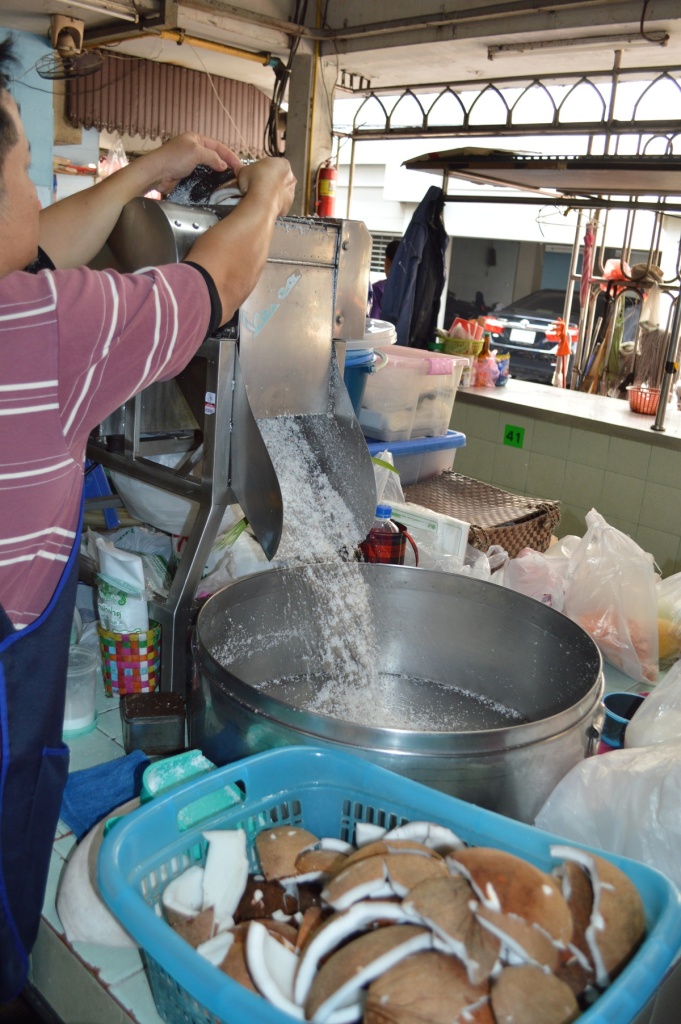
On our trip to Thailand a few years ago, I was captivated by the freshness of the ingredients. The Thai markets are filled with fresh produce and all manner of slaughtered animal parts, which is impressive enough, but then there are the prepared foods - the curry pastes, the sausages, the shrimp chips, and of course, the coconut milk. I had no idea that this was made on a small scale, but after seeing the operation, it made sense - coconut flesh could be shredded quickly, and then a small hydraulic press can crank out a few quarts of fragrant coconut milk every few minutes. We had multiple occasions to taste this fresh coconut milk (and coconut cream, will explain later), and it was starkly different from the thick, somewhat savory canned coconut milk we commonly get in the U.S. Most notably, when you smell homemade coconut milk, it smells like... coconuts! There's no plastic, fatty smell from the preservation of the liquid necessary to get it into cans and across the ocean. The freshly made milk makes no mistake in letting you know what it is, and, as I would soon learn, offers exactly the same unapologetic, coconutty brashness when made back at home with a questionably old coconut. So I watched this process, enthralled by the heavy machinery nestled within the small farmer's market, bound and determined to try replicating this at home with hand tools.


The story wasn't actually that simple. I started out thinking that the magic was all in the paste, with no appreciation for the coconut milk. Coming home armed with curry paste recipes, and having sat on the floor smashing herbs in a mortar and pestle for a few hours, I assumed I was an expert in paste making. But more than a few failed attempts back home led me to realize that those little old Thai ladies sitting around smashing up garlic all day really know what they're doing. Homemade curry paste is truly an art, and I do not have the magic just yet. Maybe it's the freshness of the ingredients, I don't know. All I know is that my pastes are too coarse and lack the depth of the ones made fresh in Thailand, or even the ones from a can here. So after one too many mediocre curries, I broke down conceded defeat, requiring much more practice to this day. Instead, I dug into the process of making homemade coconut milk. Thankfully, the gear required isn't too extensive, but it is somewhat challenging to actually do this, if you use the method I used.

We decided to use the coconut milk as part of a matsaman curry, which we really liked when we made it in Chiang Mai. Matsaman, also written massaman, means "muslim", and isn't actually a Thai word at all - it's a Thai interpretation of the Persian dish, referred to in the 19th century as "mussulman" curry, which is a dated term for Muslim. The analog of this dish is American tex-mex food: it's the native culture's interpretation of what an international dish tastes like, adapted somewhat to the local methods. In this case, the dish borrowed the spices brought to Asia by the Muslim spice traders, including cinnamon, cardamom, cloves, bay leaves, cumin, and star anise, but mixed into a paste and then fried with coconut milk, like so many other Thai dishes. It's said to be favored by westerners because of its more familiar spice palette, but honesty I don't like it any more than a good red (kaeng phet) or green (kaeng khiao wan) curry.


This recipe explores a big hack in the process - how much does homemade curry paste matter? And which is more important, high quality coconut milk, or high quality curry paste. The short answer is both, but the longer answer is that you can get a good curry paste from a pouch, but there is no substitute for homemade coconut milk. Using a commercial paste I brought back with me, the finished dish was so spectacular that I have to question if a mediocre homemade paste is in any way a substitute for a reputable packaged paste. What's more, the fresh coconut milk elevates the dish to a floral, magical level, with the subtle fruity perfume that really takes your mind to the tropics. This doesn't happen with a great curry paste and mediocre coconut milk, by converse. Given this and the other curious additions that make up matsaman curry, I'm going to advocate for skipping the paste pounding step in lieu of making your own coconut milk from now on, so long as you agree to use a decent quality paste. Agreed? Okay, let's move on.

Sunday, August 3, 2014

Blackberry Chutney over Pork Medallions

If you're lucky, where you live is berry season right now.  You're probably seeing them popping up in the grocery store on sale - $2.99 for a 6 ounce tub, trucked in from nobody knows where (aka Mexico).  But a better alternative is getting up to a farm to buy them right off the bushes, or even to pick your own.  We went up this weekend and bought 10 pounds, adding to our 10 pounds of blueberries and 5 pounds of black raspberries from an earlier trip.  You may think that this sounds like too many, but I assure you, it is not.  We now have blueberry jalapeno jelly, raspberry jam, blackberry preserves, blackberry muffins, enough frozen berries to make smoothies through the year, and this gem.

Worried for about 5 minutes that maybe we went overboard with the blackberries, we went looking for recipes.  Good old Martha Stewart came through in a pinch, bringing us an assortment of about 20 different recipes ranging from desserts through drinks, with one savory dinner option.  This dish, pork medallions with a blackberry chutney, caught my eye, since I am a huge fan of the sweet / savory pairing, as well as the meats / sweets pairing.  The recipe looked easy, and we even had a couple of shallots lying around, so it was calling to us.  And the result was fantastic - tart, sweet, and with mellow caramel undertones from the molasses and sauteed shallots, we loved the blackberry chutney so much that we're trying to figure out what else we can serve it with.  So I have chosen to rearrange the name of this dish to showcase the chutney, which was by far the star in tonight's dinner.  It came together quickly, and had a short ingredient list, although you really do want good fresh berries, so some of the ingredients can be a bit fussy.  Don't make any substitutions beyond that, and you'll do really well with this dish.


If you can find it, get a pork tenderloin.  Not loin, that's too big and tough.  Tenderloin will do you well, and will cut up and cook easily.  We couldn't get our hands on one tonight, and used pork sirloin instead, which I think is a great runner up.  Otherwise, we followed Martha's recipe verbatim, which I reprint here.

Just a small fraction of the local blackberries we picked ourselves this weekend


Sunday, July 13, 2014

Oxtails Braised in Red Wine

When I was in college, my friend and I took a trip to Atlantic City for the evening.  We didn't have much of a plan, we just went there and figured we'd do some gambling and drinking, and then head back.  Before we went off to lose our shirts, we looked around for a decent restaurant, and found a Cuban place called Cuba Libre.  It's still there, by the way.  So we sit down to eat, and we each decide to order some kind of oxtail stew they have on special, figuring that it would be interesting.  I hadn't had oxtail before, and thought it might be a great place to check it out, having fondly remembered a number of other Cuban beef stews.  But it wasn't just interesting - it was delicious.  So much so that we cleaned our plates from this massive feast, which included not only a healthy quantity of meat but also rice, plantains, and a variety of other things that have since disappeared into a haze of pan drippings and caramelized vegetables.

We never gambled that night - we stumbled into the casino, half-drunk on meat, and played slots for 5 minutes before we decided to turn back.  On a whim, I put $40 on red at a roulette table which hit and, having recovered the cost of my dinner, realized that we had won that night, big time.

This recipe is the first of two oxtail dishes that I will make - this being the more simple, more American version, cooked down slowly with red wine and root vegetables, and a future recipe being the Cuban oxtail stew, or rabo encendido.  I just found this version on the New York Times recipe page and gave it a shot, replacing a non-latin variant on this recipe I made years back because this had more wine in it, and let's face it, that's going to make it much better.  Turned out to be a winner, although it doesn't hold a candle to our Cuban feast that night.

Every bit as delicious as a chuck roast or short rib stew, if not more so.


Friday, March 14, 2014

Thai Rice Porridge with Pork (Jok Moo)

Two months ago, we went to Thailand.  On our second day, we were introduced to jok (pronounced like "joke"), which is basically the Thai version of congee, which is the Chinese version of rice that has been cooked into oblivion.  Jok may have been one of our favorite hidden gems of Thai cooking - a hearty, savory, salty, warming bowl of deliciousness with a variety of ingredients that were all delicious when paired together.  In Chiang Mai we found a vendor selling huge bowls of this for about a dollar, with a freshly poached egg and some fried noodles in it.

A cheerful jok vendor in Chiang Mai

I start here with a fairly basic recipe - rice porridge with pork meatballs.  I adapted a number of recipes to get what we thought was the right blend of flavors, and really like this process, which I think I will stick with as my basic method and adapt some of the ratios and times in the future.  It is probably the fastest way to get this done from start to finish, and adds layers of flavor at the right times.  Hopefully you will enjoy this Thai treat, and spread it further around the globe.  Make sure you get the two or three crucial ingredients for this - broken rice, white pepper, and Maggi seasoning.


Thai Rice Congee with Pork (Jok Moo)
Modified heavily from Thaifoodstyle by my recollections of Thailand

Serves 4

  • 1 cup broken jasmine rice
  • 2 cubes chicken bouillon, or 1 quart pork stock
  • 2 quarts water, or 1 quart if using pork stock
  • 2 cilantro roots, or 10-15 stems
  • ½ lb ground pork
  • 1 tbsp cilantro leaves, chopped finely
  • 1 tsp cornstarch
  • 3 tbsp fish sauce, divided
  • 2.5 tbsp soy sauce, divided
  • 1 tsp ground white pepper
  • 2 tbsp Thai cilantro, finely sliced (optional)
  • 2 spring onions, green part only, finely julienned
  • 1/2 cup ginger, julienned, or baby ginger strips in brine
  • 1 medium shallot
  • 1/2 cup canola oil
  • 4 eggs (optional)
  • White pepper, for plating
  • Maggi sauce or Bragg's Liquid Amino, for plating


Start by bringing 1 quart of water to boil with 1 chicken bouillon cube, or 1 quart pork stock, with 1 cup of broken rice.  Reduce heat to a simmer and allow to cook for 30 minutes, stirring periodically.


Once the rice is boiling, make the meatball mixture: season ground pork with chopped cilantro leaf, 1 tbsp fish sauce, ½ tbsp. soy sauce, cornstarch, and ground white pepper and mix well.  Allow to marinate for at least a few minutes, then form into small meatballs appx 0.75 - 1” in diameter.


To cook the meatballs, boil 1 quart water on medium-high heat and add coriander root.  When the water is boiling, add 1 cube chicken bouillon, allow to fully dissolve, and boil meatballs until they float, appx 2 minutes.  Remove with a slotted spoon to a plate, and add remaining 2 tbsp soy sauce and 2 tbsp fish sauce.  Let boil for 5 minutes, then keep on a bare simmer.


At this point, the rice in the other pot should have absorbed most of the liquid.  Add 2-3 cups of the boiled pork cooking liquid and stir to incorporate.  Allow rice to cook to a soupy consistency, appx 60-75 minutes.  If rice mixture isn’t thin enough, add more of remaining meatball cooking liquid. If including, fry the shallots in hot canola oil until crispy, 1-2 minutes, and allow to drain on a paper towel.


If including eggs, crack them into the boiling rice mixture towards the end and let them sit, undisturbed, for up to 8 minutes.  A runny egg will only take 4 minutes. Alternatively, use my new favorite trick of soft cooking the eggs in a sous vide setup. I'm still dialing in the numbers, but so far it's landing on 145 deg F for 45-60 minutes.

To serve, ladle into bowls sprinkled with spring onion (finely sliced), shredded ginger, and ground white pepper.  Plate with Maggi sauce or Bragg's Liquid Amino tableside.


If you want to get more exotic with this, go ahead and add the some fried shallots, crispy fried noodles, and cilantro leaves (regular or Thai variety).  These are all nice additions.  And for some reason, they like to eat this with fried bread alongside, so consider either some Navajo fry bread or just some plain donuts.  There, don't you feel multicultural now?

The current build as of June, 2016 - sous vide poached egg, fried shallots hiding behind the cilantro somewhere.

Wednesday, August 17, 2011

Thai Basil Chicken (Gai Pad Krapow)

Update 8/2025: made a refreshed version using ground pork, home grown long beans, and Thai basil (still not holy basil). Recipe reordered to cook meat first, then remove, then add back in towards the end. This version seems more vibrant and less dry.

Update 9/2024: after reading through Andy Ricker's Pok Pok Noodles book, it is very clear that I have made a huge error in describing this dish. Krapao doesn't translate as "basil", it translates as "holy basil", which is very different from the Thai basil with licorice flavor and purple stems. Reading this and confirming it all over the internet, I realize that I have no idea what this dish is really supposed to taste like, so I'll have to update this page again once I find or grow the correct basil, and get a better feel for the correct flavors. The version with Thai basil is certainly fine, but it's not authentic, and I've been spreading misinformation with what's below. Holy basil (Ocimum tenuiflorum), also known as tulsi, has notes of mint and clove in addition to licorice. I might try some of my wild basil to see if that's similar.


Original post:
It's always nice when you eat a dish in a restaurant and think "I could make this at home", and then you go home and try to make it and it's a dismal failure. Sometimes a homemade meal is a shell of its former glory, when you previously paid for a professional to make it for you. But every once in a while, you make something at home that could pass for restaurant food, if only you had shoved it into a plastic take-out container before serving yourself. And this was one of those moments.

I can't tell you how many times I've ordered pad krapow.  I believe the dish literally translates as stir-fried (pad) basil (krapow - see 9/24 correction, this is actually holy basil) with chicken (gai), which leaves very little mystery.  It is typically served in a large bowl, and consists of ground chicken, a ton of basil, and sometimes a couple of vegetables. I poked around online until I found one that sounded good, then modified it slightly to include a couple of produce items I wanted to use. The result was pretty much identical to the restaurant, although significantly cheaper, and hopefully more healthy. Apparently, the secret to this dish is a ton of fish sauce, although I'm learning more and more that this is the secret to pretty much all Thai cooking.

I've made a few dishes using Thai basil before, but have perhaps skipped over its importance. Thai Basil Chicken is not "Basil Chicken" with Thai flavoring; it is chicken that has been blessed by the infusion of Thai basil. Here's what this looks like:

Thai basil plant, from my garden.  Money well spent - I put this stuff in everything!

Notice that the leaves are not as large as those of regular basil.  I'm no botanist, but this is clearly not the same plant, and shouldn't be confused as such.  You can also probably get away with holy basil, which has more of a purple-colored leaf, and which probably tastes more like licorice than the Thai varietal.

Other than that, there are no mysteries to the ingredients.  I ground my own chicken, which is totally unnecessary unless you happen to only have whole chicken breasts and a grinder.  But other than that, this dish should come together very quickly and easily.

LinkWithin

Related Posts Plugin for WordPress, Blogger...