Nothing says winter cooking better than a good stew. Chicken cacciatore is an Italian chicken fricassee, with some added tomatoes, red wine, and olives bringing the Italian flavor on top of the usual mushrooms, onions, and garlic that are probably shared with almost all of the chicken stews out there. It translates as "hunter's style chicken", defined as having onions, garlic, and tomatoes. It actually has some commonality with Jägerschnitzel if you have tried it, given the addition of mushrooms and herbs in the sauce. And while I can't capture the smells in this post, I assure you that the combination of rosemary, onions, garlic, and sage make for some memorable comfort food.
I pulled my recipe from The Joy of Cooking, which is a great reference book for those getting started. The well-worn page of this recipe also contains Brunswick stew and coq au vin, making it easily the most used page in the whole book for me. But I'll repost the recipe here, with my notes on the process added. The recipe does state that the oil-cured olives are optional, but I highly recommend adding them, as it gives a briny, salty punch reminiscent of a good puttanesca sauce.
Showing posts with label mushroom. Show all posts
Friday, January 22, 2016
Wednesday, September 10, 2014
Crusty Chicken Thighs in Mushroom Sauce
They say never to apologize for your cooking, and unless someone dies from hysterical tastebud euphoria or E. coli, I never will. In fact, the first time I tried this, I ruined the sauce so badly that I had to improvise into a cream sauce, which became delightfully unapologetic. And okay, this recipe is staggeringly similar to that accidental recipe, crispy chicken thighs in a mushroom cream sauce, which I won't usually repost. But since it took me three tries to get this right, I'd like to post the recipe and process that inspired this whole adventure, given that it is actually delicious when done correctly. Plus, this original recipe has no added fat or carbs, making it relatively healthy. I'm still amazed by this style of cooking chicken - dry, with the lid on, yet yielding a crispy delicious skin that rivals the best hand-battered southern fried chicken. Unreal.
Having made this now enough times to get the method sorted out, I will modify the original recipe slightly with double the chicken, so that you can serve twice the number of meals. But you can't crowd the pots, so shoot for 4 thighs per cooking vessel unless you have the world's largest dutch oven.
Labels:
chicken,
French,
gluten-free,
low carb,
mushroom,
one pot meal,
quick,
wine
Wednesday, July 9, 2014
Nikujaga (Japanese Beef and Potato Stew)
I don't remember where I found the book on slow cooker dishes that contained this recipe - it was collecting dust in someone's house, and I was bored and flipping through to pass the time. While looking at soggy chicken stews, and "stir-fries" that you cooked 8 hours, I was despondent. But somewhere in the back, buried way beyond the potato soups and the poached fish with mustard dishes, and just before the wine-soaked pears, I found this gem, which is most definitely authentic, and which does very nicely in the slow cooker.
Nikujaga is an interesting dish if you know Japanese food, mostly because it's got a lot of western influence. I can't name too many Japanese dishes that have whole potato chunks - possibly golden curry, and some kind of croquette called a korokke, which I may now have to make after having looked it up. But I assure you, mention Japanese beef and potato stew to someone from Japan and they will say "NIKUJAGA!!", which I have tried a couple of times with great results.
I really like the flavors in this dish, which is slightly sweet, very rich, and incredibly filling and warming. And there's very little to this process - you chop everything, throw it in the slow cooker for the day, and come back later to eat a delicious meal. I first tried this in the pressure cooker, which took an hour, and then tried it in the slow cooker, which took 6-8 hours, and which I thought tasted nearly identical but was ready when I walked in the door. Your call. Also, if you really want to get fancy, brown the meat first in a bit of olive oil, and then continue. It will be notably better, although totally non-essential.
Labels:
beef,
japanese,
mushroom,
potato,
pressure cooker,
slow cooker,
stew,
winter
Saturday, August 17, 2013
Wild Mushroom, Barley, and Spicy Sausage Stew
After a bit of a pause, I am back to start posting again. Wanted to start with a real winner - one of those that everyone who has tried it has had rave reviews on. A soup that caters to the gluten-free without sacrificing anything. It's spicy, rich, filling, somewhat simple, and just plain delicious.
I adapted the recipe from Cooking Light: Soups, a book I highly recommend that is a collection of their most popular soup recipes. Everything in there is golden. The main changes are the mushroom type and the grain, for which I present an alternative (brown rice) for dietary restrictions. Barley is slightly preferred for a bit more bite, but only slightly. Some pictures are for the barley version, and some for the brown rice, but only because they follow almost an identical cooking process, and I have made this multiple times with progressively better photography skills.
Wild Mushroom, Barley, and Spicy Sausage Stew
adapted slightly from Cooking Light
Prep the ingredients. If using dried mushrooms, reconstitute in boiling water for up to 20 minutes. Drain, and chop into coarse bits. Slice onions thinly, remove sausage from casings.
Heat oil in a large Dutch oven over medium heat. Add onion, and cook for 5 minutes or until slightly soft. Add sausage to the pan, cooking 8 minutes or until sausage is browned and stirring to crumble. Break up with the edge of a spoon, but don't break up too finely or you'll destroy some of the body from large pieces of cooked sausage. Add celery, carrot, garlic, and bay leaf; cook 10 minutes or until onions are golden brown, stirring frequently. Stir in the mushrooms and cook 10 minutes or until mushrooms release moisture.
Once all vegetables and fungi are incorporated, stir in the barley or brown rice, chicken broth, brandy, salt, and pepper. Bring to a boil, cover, reduce heat, and simmer 1 hour or until barley is tender, or 40 minutes for the brown rice version.
Discard the bay leaf. Sprinkle with chopped parsley, and serve immediately with crusty bread and a salad.
I adapted the recipe from Cooking Light: Soups, a book I highly recommend that is a collection of their most popular soup recipes. Everything in there is golden. The main changes are the mushroom type and the grain, for which I present an alternative (brown rice) for dietary restrictions. Barley is slightly preferred for a bit more bite, but only slightly. Some pictures are for the barley version, and some for the brown rice, but only because they follow almost an identical cooking process, and I have made this multiple times with progressively better photography skills.
![]() |
| A forgiving recipe packed with flavor, great for a cold night |
Wild Mushroom, Barley, and Spicy Sausage Stew
adapted slightly from Cooking Light
- 2 tbsp olive oil
- 2 cups thinly sliced onion
- 8 ounces spicy Italian sausage (turkey or pork)
- 1 cup chopped celery, about 2 stalks
- 1 cup sliced carrot
- 2 garlic cloves, minced
- 1 bay leaf
- 3 cups dried wild mushrooms, or 5 cups fresh
- 1 1/2 cups chopped portobello mushroom
- 3/4 cup uncooked brown rice, or 1/2 cup uncooked pearl barley
- 42 ounces low-sodium chicken broth
- 2 tablespoons brandy
- 1 teaspoon salt
- 1/4 teaspoon freshly ground black pepper
- 1/3 cup coarsely chopped fresh parsley
![]() |
| Quite a few ingredients to prep, but the cooking is completely linear and almost idiot proof. |
Prep the ingredients. If using dried mushrooms, reconstitute in boiling water for up to 20 minutes. Drain, and chop into coarse bits. Slice onions thinly, remove sausage from casings.
Heat oil in a large Dutch oven over medium heat. Add onion, and cook for 5 minutes or until slightly soft. Add sausage to the pan, cooking 8 minutes or until sausage is browned and stirring to crumble. Break up with the edge of a spoon, but don't break up too finely or you'll destroy some of the body from large pieces of cooked sausage. Add celery, carrot, garlic, and bay leaf; cook 10 minutes or until onions are golden brown, stirring frequently. Stir in the mushrooms and cook 10 minutes or until mushrooms release moisture.
![]() |
| Make sure to brown the sausage, but you have a healthy error margin on this recipe. Just keep cooking until things start to develop caramel flavors, then add broth and cook for an hour. |
Once all vegetables and fungi are incorporated, stir in the barley or brown rice, chicken broth, brandy, salt, and pepper. Bring to a boil, cover, reduce heat, and simmer 1 hour or until barley is tender, or 40 minutes for the brown rice version.
Discard the bay leaf. Sprinkle with chopped parsley, and serve immediately with crusty bread and a salad.
Labels:
barley,
brown rice,
gluten-free,
italian sausage,
mushroom,
rice,
soup,
spicy,
stew
Tomato Sausage Risotto in Portobello Caps
Coming off of my last successful risotto experience, I wanted to try another flavorful risotto recipe. While I love the consistency, I have the same problem with risotto that I do with pizza - too much starch, not enough diversity of flavor. So rather than making one of the essential risottos - mushroom, or cheese, or lemon - I went with a slightly different take - a tomato-based risotto, promising a somewhat unconventional experience.
Your average risotto is made by slowly cooking the rice in hot broth as it is stirred, unfolding the starchy web on the outer layer of the rice so that it can dissolve into the cooking liquid. Chicken broth is very commonly used for this. But I was intrigued by the idea of using canned tomatoes instead of broth, just for the variety. It turns out that this is an amazing twist on your average risotto, transforming a meaty, savoury dish into a lighter, more aromatic dish. The meat still finds its way in by way of some Italian sausage, but it's a different backbone that was eye-opening and delicious.
Tomato and Sausage Risotto
Modified from Martha Stewart Everyday Food
In a small saucepan, combine tomatoes (with their juice) and 3 cups water. Bring just to a simmer; keep warm over low heat.
In a medium saucepan, heat oil over medium. Add sausage and onion; season with salt and pepper. Cook, breaking up sausage with a spoon, until sausage is opaque and onion has softened, 3 to 5 minutes.
Add rice; cook, stirring until well coated, 1 to 2 minutes. Add wine; cook, stirring until absorbed, about 1 minute.
Add about 2 cups hot tomato mixture to rice; simmer over medium-low heat, stirring occasionally, until absorbed, 4 to 5 minutes. Continue adding tomato mixture, 1 cup at a time, waiting for one cup to be absorbed before adding the next, stirring occasionally, until rice is creamy and just tender, about 25 minutes total (you may not have to use all the liquid).
Remove pan from heat. Stir in basil, Parmesan, and butter; season with salt and pepper. Why the butter? Because you're "mounting" your sauce. You heard me. It's from the French monter au beurre, meaning "build with butter" and pronounced "mount" by the less classy Americans who heard the phrase. It's the process of adding a cold fat to a hot liquid and getting it to emulsify at temperatures above where it usually breaks down into milk solids, fat, and water. Restaurants tend to do this to develop a more velvety, bodied sauce, which you have probably simply called "delicious", "rich", or "OMG". Also, they tend to put in way too much - websites I scanned just called for 1 tbsp butter per 1/2 cup of sauce, so don't get crazy mopping that stuff up with your bread.
Serve immediately, and sprinkle with additional Parmesan, if desired. For a classy presentation, grill portobello caps and use them as small serving bowls on your plate, as shown above. A recipe follows.
Grilled Portobello Caps
by me
Your average risotto is made by slowly cooking the rice in hot broth as it is stirred, unfolding the starchy web on the outer layer of the rice so that it can dissolve into the cooking liquid. Chicken broth is very commonly used for this. But I was intrigued by the idea of using canned tomatoes instead of broth, just for the variety. It turns out that this is an amazing twist on your average risotto, transforming a meaty, savoury dish into a lighter, more aromatic dish. The meat still finds its way in by way of some Italian sausage, but it's a different backbone that was eye-opening and delicious.
Tomato and Sausage Risotto
Modified from Martha Stewart Everyday Food
- 1 can (28 ounces) diced tomatoes in juice
- 1 tablespoon olive oil
- 3/4 pound sweet or hot Italian sausage, casings removed
- 1 small onion, finely chopped
- Coarse salt and ground pepper
- 1 cup Arborio or Carnaroli rice
- 1/2 cup dry white wine, or dry Vermouth
- 10 leaves basil, chiffonaded
- 1/2 cup grated Parmesan cheese, plus more for serving (optional)
- 2 tablespoons butter
In a small saucepan, combine tomatoes (with their juice) and 3 cups water. Bring just to a simmer; keep warm over low heat.
In a medium saucepan, heat oil over medium. Add sausage and onion; season with salt and pepper. Cook, breaking up sausage with a spoon, until sausage is opaque and onion has softened, 3 to 5 minutes.
Add rice; cook, stirring until well coated, 1 to 2 minutes. Add wine; cook, stirring until absorbed, about 1 minute.
Add about 2 cups hot tomato mixture to rice; simmer over medium-low heat, stirring occasionally, until absorbed, 4 to 5 minutes. Continue adding tomato mixture, 1 cup at a time, waiting for one cup to be absorbed before adding the next, stirring occasionally, until rice is creamy and just tender, about 25 minutes total (you may not have to use all the liquid).
Remove pan from heat. Stir in basil, Parmesan, and butter; season with salt and pepper. Why the butter? Because you're "mounting" your sauce. You heard me. It's from the French monter au beurre, meaning "build with butter" and pronounced "mount" by the less classy Americans who heard the phrase. It's the process of adding a cold fat to a hot liquid and getting it to emulsify at temperatures above where it usually breaks down into milk solids, fat, and water. Restaurants tend to do this to develop a more velvety, bodied sauce, which you have probably simply called "delicious", "rich", or "OMG". Also, they tend to put in way too much - websites I scanned just called for 1 tbsp butter per 1/2 cup of sauce, so don't get crazy mopping that stuff up with your bread.
![]() |
| These are the finishing ingredients - they only go in at the very end |
![]() |
| Now, stand over your dish... and mount it! |
Serve immediately, and sprinkle with additional Parmesan, if desired. For a classy presentation, grill portobello caps and use them as small serving bowls on your plate, as shown above. A recipe follows.
Grilled Portobello Caps
by me
- 2 medium portobello caps
- 1 tsp coarse dijon mustard
- 1/2 tbsp red wine vinegar
- salt and pepper
- 2 tbsp olive oil
Stir together last four ingredients, and brush onto both sides of mushroom caps. Cook on a hot grill for 5-6 minutes per side.
Labels:
basil,
italian,
italian sausage,
mushroom,
parmesan,
portobello,
rice,
risotto,
sausage,
tomato
Sunday, May 5, 2013
Risotto with Shiitake, Asparagus, and Artichoke
Here's a dish that commemorates springtime - a risotto showcasing asparagus, among other things. Risotto is that classic Italian dish using a short-grain, high starch rice that is stirred continuously during cooking to loosen the starch and create a thick, flavorful sauce that envelops the whole dish. The dish is almost always made with Arborio rice, although these days you can find arguably better rice to use, such as Carnaroli. The process also generally follows a formula - saute some aromatics, coat the rice in some oil, add a liquid while stirring, and then add the remainder of the ingredients once cooked, usually including a cheese of some kind. You can't phone this dish in - you have to stir for all you're worth for the 15-20 minutes that the rice cooks, and you have to pay attention to the doneness level so you don't ruin anything. Be on your guard, and this will be well worth the effort.
Springtime Risotto of Shiitake, Asparagus, and Artichokes
expanded on from Gourmet, May 2003
In another large heavy pot or pan, heat the oil with 1 tablespoon butter over moderately high heat until foam subsides, then saute mushrooms. You want them nicely browned, so I recommend doing this in two batches, using half of the fat each time. Don't overcrowd the pan or you will get squishy grey mushrooms! Stir occasionally, until browned, about 4 minutes. Season with salt and pepper, then transfer to a bowl.
In that same pan, cook onion in 2 tablespoons butter over moderate heat, stirring, until softened, about 3 minutes. Add the rice and cook, stirring, 1 minute. This will coat the rice grains in oil and begin frying them, which adds flavor. Add the wine to deglaze and start infusing flavor into the rice, and cook, stirring, until absorbed, about 1 minute.
Now the fun part - start cooking the rice with the broth. Ladle in 1 cup of the simmering broth and cook at a strong simmer, stirring, until absorbed, about 2 minutes. Continue simmering and adding broth, about 1/2 cup at a time, stirring frequently and letting each addition be absorbed before adding next, until rice is just tender and looks creamy, 18 to 20 minutes. There's going to be a lot of stirring involved. Now here's the most important point: it's done when the rice is cooked through, not when the broth is gone. Keep tasting periodically as you get towards the end, and when the rice has just a bit of bite left (called al dente or "to the tooth", like a pasta), you're done. Save any leftover broth for thinning as needed.
Remove from heat and stir in 1/2 cup cheese, remaining tablespoon butter, and salt and pepper to taste. Gently fold in asparagus, artichokes and mushrooms, then cover pan and let stand for 1 minute. If desired, thin risotto with some of remaining broth. Serve immediately with remaining cheese on the side.
Springtime Risotto of Shiitake, Asparagus, and Artichokes
expanded on from Gourmet, May 2003
- 5 cups chicken broth (40 fl ounces)
- 1 cup water
- 1 pound thin to medium asparagus, trimmed and cut into 1/4 inch thick slices, leaving tips 1 1/2 inches long
- 1 tablespoon olive oil
- 1/2 stick (1/4 cup) unsalted butter
- 3/4 pound fresh shiitake mushrooms, stems discarded and caps cut into 1/4 inch thick slices
- 2 artichoke hearts, fresh if available, jarred if not
- 2 shallots, finely chopped
- 1 1/2 cups Carnaroli or Arborio rice (10 ounces)
- 1/2 cup dry vermouth
- 2 ounces finely grated Parmigiano-Reggiano (1 cup)
![]() |
| Shiitakes add a great earthy flavor and meaty consistency to this otherwise meat-free (except the broth) dish |
![]() |
| Shallots. Only way this dish would get better is if I put in flakes of gold. |
First, we have to blanch the asparagus - boil to partially cook, then stop the cooking process in ice water. Usually you just use water to boil, but we can do double duty and start heating up the broth here, which saves a pot. So bring the broth and water to a boil in a large pot, then add asparagus and cook, uncovered, until crisp-tender, 3 to 4 minutes. Immediately transfer the asparagus with a slotted spoon to a large bowl of ice water to stop the cooking, reserving the hot broth which you should keep at a simmer. Drain the asparagus and set aside.
![]() |
| Digitize your asparagus. Anybody ever see that movie Tron? |
![]() |
| Blanch in the broth - cook 3-4 minutes, then shock in ice water. Now the asparagus is ready to add at the last step, cooked and ready to go. |
In another large heavy pot or pan, heat the oil with 1 tablespoon butter over moderately high heat until foam subsides, then saute mushrooms. You want them nicely browned, so I recommend doing this in two batches, using half of the fat each time. Don't overcrowd the pan or you will get squishy grey mushrooms! Stir occasionally, until browned, about 4 minutes. Season with salt and pepper, then transfer to a bowl.
![]() |
| Brown the mushrooms. You don't want to see moisture coming out - do this in two batches |
![]() |
| The mushrooms came out great, but are easily ruined |
In that same pan, cook onion in 2 tablespoons butter over moderate heat, stirring, until softened, about 3 minutes. Add the rice and cook, stirring, 1 minute. This will coat the rice grains in oil and begin frying them, which adds flavor. Add the wine to deglaze and start infusing flavor into the rice, and cook, stirring, until absorbed, about 1 minute.
![]() |
| Add the rice and toss to coat in the oil |
Now the fun part - start cooking the rice with the broth. Ladle in 1 cup of the simmering broth and cook at a strong simmer, stirring, until absorbed, about 2 minutes. Continue simmering and adding broth, about 1/2 cup at a time, stirring frequently and letting each addition be absorbed before adding next, until rice is just tender and looks creamy, 18 to 20 minutes. There's going to be a lot of stirring involved. Now here's the most important point: it's done when the rice is cooked through, not when the broth is gone. Keep tasting periodically as you get towards the end, and when the rice has just a bit of bite left (called al dente or "to the tooth", like a pasta), you're done. Save any leftover broth for thinning as needed.
![]() |
| Stir the rice while adding broth |
Remove from heat and stir in 1/2 cup cheese, remaining tablespoon butter, and salt and pepper to taste. Gently fold in asparagus, artichokes and mushrooms, then cover pan and let stand for 1 minute. If desired, thin risotto with some of remaining broth. Serve immediately with remaining cheese on the side.
Sunday, December 23, 2012
Crispy Chicken Thighs in Mushroom Cream Sauce
As you may know, sometimes out of accidents amazing things are born. I cite here vulcanized rubber, penicillin, Coca-Cola, teflon, and this chicken recipe. I tried to make a dish from Jacques Pepin's Fast Food My Way calling for a quick cooked chicken thigh in a very fast mushroom pan sauce, but I tried to cut too many corners and came up with something that, while looking unappetizing, tasted amazing. So I took it a step further and turned it into a cream sauce, preserving the cooking technique for the chicken and the sauce but adding a few steps and ingredients. I was amazed with the results, which were still easy and amazingly delicious. The mushroom cream sauce is on par with the best cream of mushroom soup I've ever eaten, just FYI.
You can make either the chicken, the sauce, or both, and any part of this will be great. I had never seen this technique for cooking chicken, which is strange on at least two levels, but it really works. I will definitely be using it in the future. And while I'm not sure how he even figured it out, I will say that Jacques is a miracle worker of quick-cooked food techniques.
Thursday, December 6, 2012
Wild Rice and Mushroom Soup
If you're looking to cut back on the amount of meat in your diet without sacrificing flavor, I find that soups are usually a good place to find a ton of flavor packed into a few vegetables (and maybe a fungus or two). In this case, I found a great soup recipe from Cooking Light Soup in need of very little modification to make it quite hearty. It's not fully vegetarian, nor would I want it to be, but I suppose you could make it so by swapping the chicken broth for vegetable stock.
Not only is there a fungus in this soup, but there's also a bunch of grass. Wild rice isn't a grain like regular rice - it's actually a grass, mostly grown in North America and traditionally harvested by paddling a canoe around and knocking the ripe heads off into the boat. That's why the stuff is so expensive. The good stuff has a nutty taste and takes forever to cook, so don't expect it to be ready in 20 minutes like white rice. The bad stuff is cut with regular rice and sold as a 'wild rice blend', often including seasoning salts and other nonsense, and usually containing not much more than about 10% actual wild rice. The EXCELLENT stuff is still harvested by hand from the Great Lakes region, mostly from Minnesota, and can cost you well over $10/pound, but I hear that it's worth it. If you want to go all out, get some from Zingerman's up in Michigan. I found a bag of the decent stuff at Trader Joe's for a decent price.
![]() |
| Grains of pure, unadulterated wild rice, marching off on their final mission |
![]() |
| This is how your wild rice used to (and in some cases still does) get to your plate. Be grateful you stayed in school - this could be you. |
Wild Rice and Mushroom Soup
From Cooking Light Soup, modified by me
- 2 tsp butter
- 8 ounces button or baby portabella mushrooms, sliced
- ½ cup chopped carrot (1 medium)
- 1 large onion, chopped
- 2 celery stalks, thinly sliced (~3/4 cup)
- 1 tsp chopped fresh rosemary
- ¼ tsp black pepper
- 3 garlic cloves, minced
- 2 14 oz cans chicken broth
- 1 cup uncooked wild rice
- 1/3 cup all-purpose flour, lightly spooned into dry measuring cup
- 2 ¾ cups 2% milk
- 2 tbsp dry sherry
- ¾ tsp salt
![]() |
| I always buy whole mushrooms and slice them myself - much more fresh that way |
![]() |
| All you need now are the holy trinity of vegetables, plus some fresh rosemary |
Melt butter in a Dutch oven over medium-high heat. Add mushroom and sauté for 5 minutes, stirring often, to brown the mushroom slices. Add carrot and next 5 ingredients; sauté 8 minutes or until tender. If necessary, add another teaspoon of butter to promote cooking. Stir in broth, scraping pan to deglaze browned bits. Stir in rice and bring to a boil. Cover, reduce heat, and simmer 75 minutes or until rice is tender.
Combine flour and cold milk in a small bowl, stirring with a whisk. Add to soup mixture. Cook out raw flour for 10 minutes until soup is thickened, stirring frequently. Stir in salt, kill heat, and either pour in sherry or drizzle individually over each bowl. Serve immediately.
![]() |
| Drizzle the sherry in at this point, and you're done! |
Sunday, December 2, 2012
Mushroom and Raisin Chutney
Poking through an excellent book by Jacques Pepin - Fast Food My Way, which is based on his public television series that brings a touch of European class to the quick and easy cooking style of Rachael Ray - I found a very bizarre sounding recipe for a mushroom chutney with raisins, tomato paste, and white wine. It was almost like a quick pickling process, where you heat everything for a couple of minutes and then throw it into a mason jar to store in the fridge. We served this with our Thanksgiving dinner, having made it the day before. It was delicious, but I couldn't quite pin down the country that I thought this was from. It almost had a Moroccan feel to it, but was made distinctly European from the addition of the barely simmered wine. I highly recommend trying this out and serving either on its own or with some simple, roasted meat dishes.
Mushroom and Raisin Chutney
From Fast Food My Way, by Jacques Pepin
Put all ingredients in a nonreactive saucepan. Bring to a boil, cover, reduce the heat to low, and boil gently for 5 minutes. Cool.
Serve cold from the refrigerator or at room temperature.
Mushroom and Raisin Chutney
From Fast Food My Way, by Jacques Pepin
- 1 lb white buttom mushrooms, quartered
- 1/3 c dark raisins
- 2 tbsp olive oil
- 2 tbsp tomato paste
- 1/2 tsp mustard seeds
- 2 bay leaves
- 1/3 c dry white wine
- 2 tsp chopped peeled fresh ginger
- 1 tbsp chopped garlic
- 1/2 c coarsely chopped onion
- 3 tbsp red wine vinegar
- 1 1/2 tsp sugar
- 1/2 tsp black pepper
- 1 tsp salt
![]() |
| A fairly simple list of ingredients with minimal prep |
![]() |
| Not a lot to do, either - just throw everything in a pot for a few minutes |
Put all ingredients in a nonreactive saucepan. Bring to a boil, cover, reduce the heat to low, and boil gently for 5 minutes. Cool.
Serve cold from the refrigerator or at room temperature.
Sunday, May 20, 2012
Buddha's Delight (Jai)
Today I made Jai, also called Buddha's Delight. It's amazing that a dish with such a short name has such a long list of ingredients, ranging from the poisonous to the floral. I wish I had a great backstory on why I made this dish, but the real answer is that I associated the name of this dish with 'vegetables and tofu', and told my vegetarian friends that I would make it figuring it would be easy. But on closer inspection, I learned that this is actually a very complex dish served at Chinese New Years and celebrating longevity, prosperity, and good health and fortune, with each of those things being represented by multiple [obscure] ingredients. It sounded so unique, though, that I forged ahead anyway.
I spent over an hour wandering aimlessly through the most Asian of all the Asian grocery stores in my area, where I was by far the most confused looking person in there, repeatedly asking for insane things like 'lily blossoms' and 'gingko nuts'. But after hard searching, I was able to find everything I needed to make this dish, if not a bit exhausted. Good thing this came together quickly... oh wait, it was the most involved stir-fry I've ever made. I will state outright that this was one of the more extensive Chinese dishes I've made, but that it was also one of the most interesting. There were flavors in here I've never had before, and they were nicely balanced - rich, bitter, floral, fragrant, crunchy, chewy, and very colorful.
I do not recommend this dish for beginners: I would rank this at 4 ice cream cones out of a maximum 5 in terms of difficulty, just because of the sheer prep work and item hunting. But if you're feeling daring, give this a shot. The recipe I present here is an amalgamation of multiple recipes I found online and fused into something I thought would be a fair representation of the average tastes and components of this dish, so I will not list a citation but rather tip my hat to those who have bravely attempted this before me.
I will try my best to explain some of the crazy ingredients you're about to see, hopefully complemented by the annotated picture below. This is probably a good primer on some basic Asian ingredients anyway.
| Check out this ridiculous ingredient set! |
A. Soy sauce. This is often confusingly referred to as 'light' soy sauce, not to be mistaken for 'low sodium' soy sauce, because 'dark' soy sauce contains sugar, and is thicker. I didn't have the dark (even though it is called for in the recipe), so I used all light and extra sugar.B. Oyster sauce. Made from oyster bits, not for those with shellfish allergies.C. Chinese rice wine. I have no idea where to get good Shaoxing wine, but if you know please share! This stuff here is basically the same as the Marsala wine you find in the grocery store by the salad dressings, the Sunny Delight of orange juice, the Cool Whip of clotted cream - it's a terrible approximation of the real thing, but it's all I know.D. Sesame oil. Nothing to add here.E. Ginger. The recipe calls for "one knuckle", which we defined as "about 1 inch long piece".F. Napa cabbage. Not to be confused with standard Savoy cabbage, this is longer and more delicate.G. Water chestnuts. Yes, you can buy these canned, but I wanted to try fresh. To use, just cut off the top and bottom, then peel around the sides with a sharp knife. It's nothing like normal chestnuts (and I don't think they're even related botanically), so not nearly as much of a pain in the ass to deal with.H. Carrots. Duh.I. Snow peas. These are the thin peapods, not the same as English peas or sugar snap peas, both of which are fatter. Very common in stir-fries.J. Gingko nuts. NOW we're in weird territory. These were eventually located in the refrigerated section by the tofu, and have thankfully been processed out of their shells. Raw, they look like pistachios, but it turns out these are mildly toxic in large doses, and fairly bitter when eaten fresh out of the pack. Relax, they're no less toxic after cooking, so I didn't compromise my endocrine system any more than you will. Apparently the layer between the nut and shell causes allergic dermatitis, so use gloves if you get them unprocessed. The nuts have a slightly bitter aftertaste out of the pack, which mellows after stir-frying. They have a consistently between a semi-firm cheese and a hard-boiled egg yolk. Bet you can't wait to try them after that description, right? And no, I don't believe these make you smarter - that's the leaves of the plant, not the nuts. Clearly the guy eating the poisonous nuts instead of the leave missed the boat by inches on this [almost] brain food.K. Fried tofu. Pretty much the same product as you would end up with at home if you took tofu, wrung it out, and went to the trouble of frying it, but much more convenient.L. Bamboo shoots. I usually buy the finely sliced stuff, but went for large pieces this time. I could have gone for the raw stuff out of a sketchy looking tub at the store, but didn't feel quite that daring.M. Lily buds. I had no idea what this meant as I wandered the aisles, and was literally looking for dried flowers in a bag until someone pointed out that these come shredded. They smell like tea, and taste floral and delicious. A nice counterpoint to the gingko nuts.N. Bean curd sheets. This was another one that took forever to find, since I didn't know what I was looking for. Think of this product like you would pudding skin - it's the film that forms on top of the tofu whey as it's being made, which they skim off. It's very rich, and almost tastes buttery. A little goes a long way; we broke off 4" pieces and cut them in half to serve, but should have chopped finer.O. Dried Shiitake mushrooms. These are pretty common in Asian grocers.
So, you ready? Let's have a go at...
Buddha’s Delight (Jai)
by: Me!
by: Me!
- 4 dried Shiitake or Chinese black mushrooms
- 1/2 cup dried lily buds
- 4 dried bean curd sticks
- 8 ounces fried tofu (store bought or homemade)
- 8 ounces bamboo shoots
- 6 fresh water chestnuts
- 2 large carrots
- 1 cup shredded Napa cabbage
- 4 ounces snow peas
- 1/4 cup canned gingko nuts
- 1 knuckle of ginger, crushed
- Cellophane noodles
- Vegetable or peanut oil for stir-frying, as needed
- 1/4 cup mushroom soaking liquid
- 1.5 tbsp Shaoxing wine or Chinese rice wine
- 1 tsp ginger, minced
- 1 tbsp vegetarian oyster sauce
- 1 tbsp light soy sauce
- 1 tsp dark soy sauce
- 1/2 tsp sugar
- 1/2 tsp sesame oil
- 1/2 tsp cornstarch
In separate bowls, soak the mushrooms, dried lily buds, and dried bean curd sticks in hot water for 20 to 30 minutes to soften. Squeeze out any excess liquid. Reserve the mushroom soaking liquid, straining it if necessary to remove any grit. Remove the stems and cut the mushroom tops in half if desired. Soak cellophane noodles just before using.
Slice the bamboo shoots into large pieces. Peel and finely chop the water chestnuts. Peel the carrots, cut in half, and cut lengthwise into thin strips. Shred the Napa cabbage. String the snow peas and cut in half. Drain the gingko nuts. Crush the ginger.
Combine the reserved mushroom soaking liquid with the Chinese rice wine or sherry, 1 tsp ginger, oyster sauce, soy sauces, sugar, sesame oil, and cornstarch. Set aside.
Heat the wok over medium-high to high heat. Add 1 tablespoon oil to the heated wok. When the oil is hot, add tofu and bean curd with a little salt and sugar, and stir fry for 1-2 minutes. Remove, then follow same process for the gingko nuts and remove.
![]() |
| Stir-fry the proteins with a bit of salt and sugar, and set aside |
![]() |
| Follow the same process for these crazy gingko nuts |
Add more oil, then stir-fry the carrots. Stir-fry for 1 minute, and add the dried mushrooms and lily buds. Stir-fry for 1 minute, and add the water chestnuts, bamboo shoots, snow peas and ginger.
![]() |
| This is everything before the cabbage and noodles |
Stir in the shredded cabbage and return all other cooked ingredients
back to the wok, and then add noodles after cabbage has wilted
slightly.
![]() |
| The soaked cellophane noodles. Don't let them sit in hot water too long, or they will turn mushy. |
![]() |
| Add the sauce and fold in, allowing to come to a boil to thicken up the cornstarch mixture |
Add the sauce ingredients and bring to a boil. Cover, turn down the heat and let the vegetables simmer for 5 minutes. Taste and add salt or other seasonings as desired. Serve hot.
Sunday, March 11, 2012
Beef Stroganov
I had some friends in town and decided to make this recipe, which I'd been saving for a while. It was a lot of fun to make, because it involved some of my favorite things - fire, large hunks of meat, steam, and cast iron. Taken out of context, this might mean I'm either ready to wage war or check myself into a ward, but at least in the kitchen this makes sense.
I did a bit (translated: 4 seconds on Wikipedia) of research on this dish, and discovered first that it should probably be called Stroganov, and not Stroganoff, because it's most likely named after the Russian family of that name, and therefore giving it the French spelling with the 'ff' is pretty much a slap in the face to this family, and might kick off another Cold War. The dish is typically a meat stew, either beef or chicken, served commonly in a creamy, dairy-based sauce, and either over rice or pasta. Somehow the recipe has been embraced by Iran, England, Japan, China, Sweden, Portugal, and a few others, though of course it's different in each country.
Though the dish in America typically calls for sour cream, it turns out that the Russians use their own, more epic soured cream called smetana, which is apparently richer and won't curdle, which can't be said for my light sour cream. But alas, I was not able to find this in the grocery store, nor did I actually look for it. The flavor and mouthfeel came out just fine, in my ignorant taste buds' opinion.
If you look up the original recipe I stole (which you shouldn't, it's more boring), it doesn't call for actually lighting the onions on fire. But my version ended up receiving much fanfare, and produced amazing smells from sauteed onions that I had to resist eating right out of the pan. So if you are bold, I recommend a bit of flambe when you make this.
Beef Stroganov
mostly liberated from Tyler Florence, with adjustments
- 5 tablespoons olive oil
- 4 (5 to 6-ounce) London broil, cut into 2-inch cubes
- 1 1/2 cups finely chopped onion
- Salt and freshly ground black pepper
- 3 sprigs thyme
- 3 tbsp cognac or brandy
- 1 cup dry red wine
- 1 1/2 cups beef broth
- 3 tablespoons unsalted butter
- 3 cloves garlic, chopped
- 1/2 pound fresh shiitakes, stems discarded and caps thinly sliced (about 2 cups)
- 1/2 pound white mushrooms, trimmed and thinly sliced (about 2 cups)
- ¼ cup sour cream, plus more for garnish
- 1 tablespoon Dijon mustard
- 2 tablespoons chopped fresh parsley leaves, plus more for garnish
- 1 package egg noodles
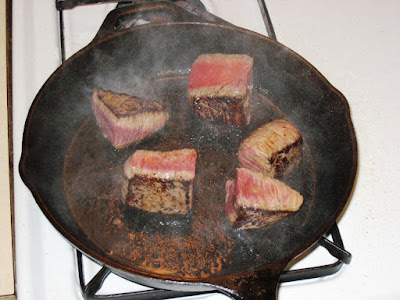
Pat the beef dry and season it with salt and pepper. Heat 3 tablespoons oil in a large heavy bottomed skillet over high heat. Fry the meat in batches so that it is browned on all sides, placing on a plate if using a regular pot, or transferring to the pressure cooker if you are using it. Lower the heat to medium and, if not using a pressure cooker, return all the meat to the pot. Add the onions and cook until they are soft, about 5 minutes.
Now carefully, pour in the cognac and flame until alcohol cooks off. You may consider turning off the stovetop before you do this, at the risk of screwing up and losing your arm hair, although if you are a woman maybe this isn't such a bad thing (though you didn't hear it from me). You can either tilt the pan to expose the vapors to the stovetop flame, or better yet, use a long fireplace starter to ignite remotely. Cook, shaking if you wish, until the flames die out. If the flames reach your ceiling, please contact the distributor of your alcohol for a full refund on the price of your home. A good safety guideline is to have a tight-fitting lid for the pan at the ready, to smother the fire if it gets out of control.
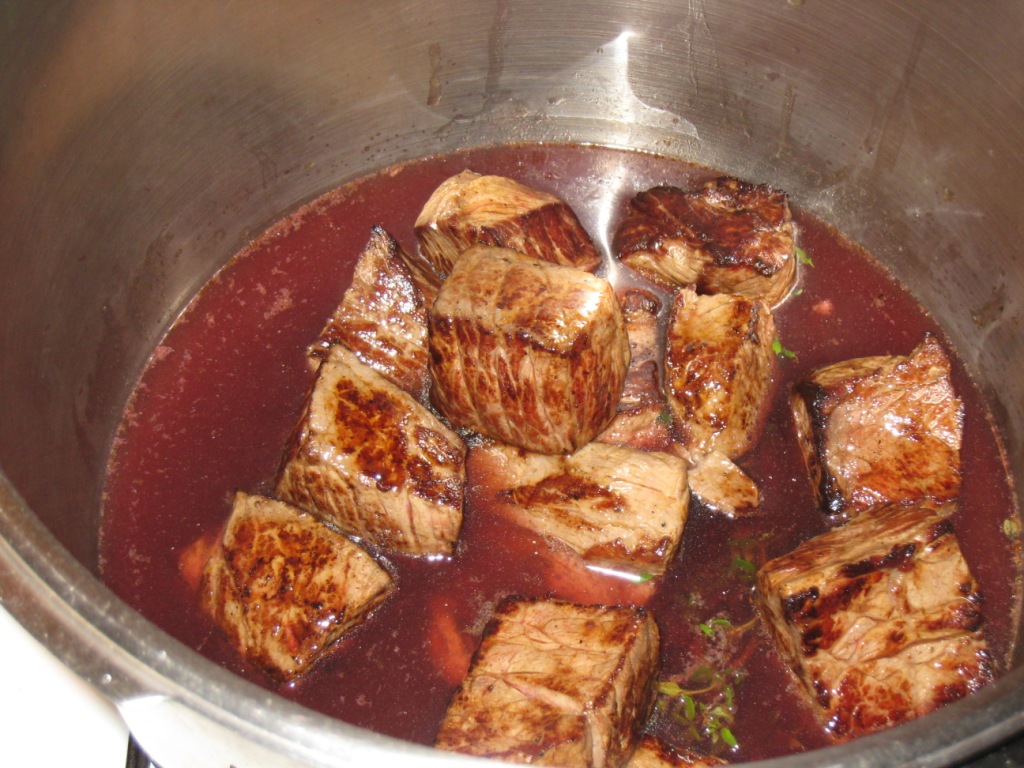
Once the onions are properly flamed, add the beef stock and red wine, or transfer to the pressure cooker and add everything to that. Cook, partially covered, over a very low flame for 1.5 - 2 hours, or in a pressure cooker for 45 minutes. Towards the end, start boiling a large pot of water for the noodles.
![]() |
| Fully browned meat, hanging out in a trench of red wine before its timely demise in the grip of my pressure cooker |
In a large skillet over medium heat, melt 3 tablespoons butter in the remaining 2 tablespoons olive oil. Add the mushrooms, garlic, and remaining 3 thyme sprigs and cook until the mushrooms are browned and cooked through. Remove from heat and set aside.
![]() |
| For a bit of variety and some more interesting flavor, don't skip on the shiitake mushrooms. |
Boil egg noodles according to package directions. Drain and have ready to plate.
When the meat is done, remove it from the heat and fold in the mushrooms, sour cream, mustard, and parsley. Taste and adjust the seasoning with salt and pepper. Serve stroganov with buttered noodles and a green vegetable of your choice.
![]() |
| The final setup |
![]() |
| Add the mushrooms, sour cream, parsley, and mustard off the heat |
![]() |
| The finished dish, served with asparagus over egg noodles. High marks from all. |
Labels:
beef,
braise,
brandy,
flambe,
mushroom,
pasta,
pressure cooker,
sour cream,
stew,
Stroganoff,
Stroganov
Subscribe to:
Posts (Atom)