

Showing posts with label tomato. Show all posts
Showing posts with label tomato. Show all posts
Monday, February 15, 2016
Lasagna-stuffed spaghetti squash: a fun alternative
If you're looking for a way to take something totally unhealthy and turn it into something only mildly unhealthy, then look no further! This recipe converts the standard lasagna into one that uses spaghetti squash, a fun winter squash that pulls apart into threads (not unlike spaghetti) once sufficiently cooked. It may leave you wanting a bit, given the lower calorie count, but at least you won't hate yourself as much later that night. Plus, it's incredibly fun to eat.


Wednesday, September 10, 2014
Pasta alla Norma
Many years ago I traveled with my family to our homeland of Sicily to see where the family was from. We toured around the island, tracking down birth certificates and marriage licenses. It was an amazing trip, punctuated with unforgettable meals.
Sicilian food isn't the same heavy cuisine as the northern parts of the country; instead, the food of the island represents a melting pot of influences and a culture that has thrived on meager existences. This classical dish, pasta alla norma, took us by surprise at how much flavor was packed into such few ingredients, cooked just barely enough to bring out the essence of each one. I think that this dish could represent the humble beginnings of tomato use in Italy, coming over from the Americas and passed by the Spaniards to the Italian islanders. In the beginning, tomatoes were often barely cooked rather than being pureed into sauces, and were often tossed with some form of grain and maybe a couple of other vegetables. So this dish is essentially a trip backwards in time through the history of the Italy's "golden apple".

I present a very classical recipe, not unlike ones I found by Mark Bittman and Mario Batali. You can plate this however you like, but I relish the crudeness of the ingredients and prefer to serve this as large bites of everything, an homage to the basic vegetables that would go on to form the much more eloquent language of an entire cuisine over the centuries.
Sicilian food isn't the same heavy cuisine as the northern parts of the country; instead, the food of the island represents a melting pot of influences and a culture that has thrived on meager existences. This classical dish, pasta alla norma, took us by surprise at how much flavor was packed into such few ingredients, cooked just barely enough to bring out the essence of each one. I think that this dish could represent the humble beginnings of tomato use in Italy, coming over from the Americas and passed by the Spaniards to the Italian islanders. In the beginning, tomatoes were often barely cooked rather than being pureed into sauces, and were often tossed with some form of grain and maybe a couple of other vegetables. So this dish is essentially a trip backwards in time through the history of the Italy's "golden apple".
Wednesday, August 6, 2014
Quick Stewed Okra and Tomatoes
I just got back from Charleston, SC, where I had an amazing time and ate way too much food. If you haven't been there, I can describe the food as French-influenced low country cooking with a healthy dose of Southern backbone. So take all of the soul food you love - fried chicken, fried green tomatoes, shrimp and grits, collards - and put it alongside po' boys, remoulades, beignets, and all manner of creole food. There's a kind of third culture mixed in - the Gullah people - who descended from slaves in South Carolina and Georgia. They too are technically creole people, so it should come as no surprise that they also claim dishes like shrimp and grits, fried okra, and a wide variety of other dishes that come from some hazy part of the South that I can't quite seem to put a dotted line around.
The point of this ramble is simple - they have excellent food in Charleston. And the trip there reaffirmed my love of okra, an underappreciated vegetable here in the North. For the first time, I tried a new dish I hadn't heard of before - stewed tomatoes with okra - that I thought was spectacular. Served alongside eggs, bacon, and the best grits I've ever eaten, this dish would replace a broiled tomato or a bowl of stewed tomatoes, which I have historically despised. But if you add in okra's earthy vegetation and change up the texture of tomatoes by adding in the okra pods and seeds, it becomes something entirely different. I made a version of this dish tonight based on what I thought it should taste like, and while the dish wasn't as brightly red colored as the one I had at Kitchen 208, they were also plated more thoughtfully, and had the same amazing flavor I've been craving for a whole week since my return. So don't be afraid of okra, brave cooks, and push yourself to tackle this otherwise forgotten mallow.

The point of this ramble is simple - they have excellent food in Charleston. And the trip there reaffirmed my love of okra, an underappreciated vegetable here in the North. For the first time, I tried a new dish I hadn't heard of before - stewed tomatoes with okra - that I thought was spectacular. Served alongside eggs, bacon, and the best grits I've ever eaten, this dish would replace a broiled tomato or a bowl of stewed tomatoes, which I have historically despised. But if you add in okra's earthy vegetation and change up the texture of tomatoes by adding in the okra pods and seeds, it becomes something entirely different. I made a version of this dish tonight based on what I thought it should taste like, and while the dish wasn't as brightly red colored as the one I had at Kitchen 208, they were also plated more thoughtfully, and had the same amazing flavor I've been craving for a whole week since my return. So don't be afraid of okra, brave cooks, and push yourself to tackle this otherwise forgotten mallow.
Monday, July 14, 2014
Curried Cauliflower with Chickpeas and Tomatoes
Every week I got to my local farmer's market, and pick up food for the week. Greens, eggs, bread, apples, whatever. But there are plenty of things I stroll on past, like the homemade dips, mini pies, and piles of cauliflower.
You know how if you see the same thing hundreds of times, even if you don't really like it, you start to think about it? Well, that must have been what happened, because last week I suddenly thought "we need to buy one of these heads of cauliflower and see if we can make something with it." Naturally, I didn't go for the white cauliflower, I had to get the purple kind (which is apparently high in anthocyanins and their cancer-fighting powers) because it looked more weird. I found an old recipe I have kept in reserve until I found myself with a head of the stuff for whatever reason, and filled in the rest of the ingredients.
This dish was delicious, and had us coming back for more. I think it was from one of Tyler Florence's cookbooks since I found the identical recipe on one of his pages, but I couldn't identify the scanned page. Slightly spicy, filling, nice mixture of texture, and velvety from the reduced tomato sauce melding with the ghee - an Indian clarified butter.

Once again, I implore you to use dried chickpeas with this dish as opposed to canned. Cheaper, better, and more healthy, these are far superior and only require minimal extra effort and probably an extra hour (or 13 if you pre-soak) of prep time.
The dish comes together quickly, and only requires a single pot - I reused the one from boiling the soaked chickpeas. We are new converts to cauliflower, so expect more recipes using it soon.
You know how if you see the same thing hundreds of times, even if you don't really like it, you start to think about it? Well, that must have been what happened, because last week I suddenly thought "we need to buy one of these heads of cauliflower and see if we can make something with it." Naturally, I didn't go for the white cauliflower, I had to get the purple kind (which is apparently high in anthocyanins and their cancer-fighting powers) because it looked more weird. I found an old recipe I have kept in reserve until I found myself with a head of the stuff for whatever reason, and filled in the rest of the ingredients.
This dish was delicious, and had us coming back for more. I think it was from one of Tyler Florence's cookbooks since I found the identical recipe on one of his pages, but I couldn't identify the scanned page. Slightly spicy, filling, nice mixture of texture, and velvety from the reduced tomato sauce melding with the ghee - an Indian clarified butter.
Once again, I implore you to use dried chickpeas with this dish as opposed to canned. Cheaper, better, and more healthy, these are far superior and only require minimal extra effort and probably an extra hour (or 13 if you pre-soak) of prep time.
The dish comes together quickly, and only requires a single pot - I reused the one from boiling the soaked chickpeas. We are new converts to cauliflower, so expect more recipes using it soon.
Monday, June 23, 2014
Shakshuka (North African Eggs Poached in Peppers and Tomatoes)
Shakshuka apparently means "mixture" in Arabic slang, and that's exactly what you get with this delicious and unique vegetarian dish. Served for lunch more than it is for breakfast, this poached egg dish boasts an incredible amount of healthy flavor and a pleasing array of silky textures achieved by slowly cooking the eggs in a bed of unbelievable flavors. It's a common dish in Morocco and Tunisia among other places. Think of it as a much more delicious, much more Middle Eastern version of huevos rancheros, if you've ever had that.

We found this worldly delight at a vegetarian cooking class based on Yotam Ottolenghi's book Plenty. Yotam was recently on an episode of Anthony Bourdain's Parts Unknown, so he's a credible source now that he's been on TV, for as John Cleese once said at a talk of his I attended, "I don't have to be an expert, but I am a celebrity". If you have the patience in the morning to simmer this dish while you wait for epic mealtime, I highly recommend you give this a shot. He's a very passionate chef with a great approach to his vegetarian dishes, and I definitely encourage you to not only try this, but have a look at his book.
Shakshuka
from Plenty, by Yotam Ottolenghi


We found this worldly delight at a vegetarian cooking class based on Yotam Ottolenghi's book Plenty. Yotam was recently on an episode of Anthony Bourdain's Parts Unknown, so he's a credible source now that he's been on TV, for as John Cleese once said at a talk of his I attended, "I don't have to be an expert, but I am a celebrity". If you have the patience in the morning to simmer this dish while you wait for epic mealtime, I highly recommend you give this a shot. He's a very passionate chef with a great approach to his vegetarian dishes, and I definitely encourage you to not only try this, but have a look at his book.
Shakshuka
from Plenty, by Yotam Ottolenghi
- 1/2 tsp cumin seeds
- 3/4 cup light olive oil
- 2 large onions, sliced
- 2 red bell peppers, cut into 3/4" strips
- 2 yellow bell peppers, cut into 3/4" strips
- 4 tsp raw sugar
- 2 bay leaves
- 6 thyme sprigs
- 2 tbsp parsley
- 2 tbsp chopped cilantro, plus more for garnish
- 6 ripe tomatoes, roughly chopped
- 1/2 tsp saffron threads
- pinch cayenne pepper
- salt and black pepper
- 8 eggs
In a large heavy pan, toast the cumin seeds on high heat for 2 minutes. Add the oil and the onions, and saute for 5 minutes. Add the peppers, sugar, and herbs, and continue cooking on high heat for 5-10 minutes further.
Add the tomatoes, saffron, cayenne, and some salt an pepper. Reduce the heat to low and cook for 15 minutes, stirring occasionally. Make sure not to overcook; add water as necessary to maintain a thick sauce consistency with minimal evaporation. This should be incredibly potent and thick at the end of this process.
If placing into individual serving pans, divide mixture into 4 deep frying pans. Remove the bay leaves, then make small wells in the mixture. Crack the eggs into a small dish one at a time, and pour the eggs gently into the wells in the mixture in 8 spots. Sprinkle with salt and cover the pan(s) with lids. Cook on very low heat for 10-12 minutes, until the eggs are just set. Don't cook this too fast, or the eggs will be tough.
Sprinkle with chopped cilantro and serve.
Saturday, February 8, 2014
Italian Braised Pork Ribs with Tomatoes
Tired of your average BBQ ribs? Looking for something new? Search no further, I have the answer for you! Trust in the Italians, those masters of piquancy and lovers of all things tomato (even though European explorers discovered tomatoes here in the Americas in the 1500s and introduced them to Italian cuisine only 600 years ago, but that's not the point). There is a Roman dish called Italian Country Style Ribs, which I pull from the book Roma: Authentic Recipes from In and Around the Eternal City. Don't worry, I looked at the reviews and you're not missing anything by not running out to purchase this book. Let me rework this recipe that was reposted anyway, and you'll reap the rewards without trying to chase down the book. I have modified it to avoid the use of the oven, and instead rely on my favorite of cooking methods - the pressure cooker. If you are scared of the pressure cooker, first, shame on you, and second, you can bake at 350 F and wait around for dinner, and think about what you could be doing with those extra 2 hours of your life if only you were more courageous (I'm looking at you, Mom).

Italian Country Style Ribs with Tomatoes
From Roma: Authentic Recipes from In and Around the Eternal City
Pat ribs dry with paper towel and season on both sides with salt and pepper. Heat olive oil over medium-high flame in a heavy cast iron skillet. Brown the ribs well on both sides, turning them a couple/few times, about 10 minutes total. Avoid crowding them in the pot. Meanwhile, pour tomatoes into a bowl roughly chop them.

Transfer ribs to a plate and reduce heat to medium. Add onion, carrot and celery to pot and cook for 5 to 6 minutes, stirring frequently to avoid burning. Stir in garlic, rosemary and paprika and cook until fragrant, about 45 seconds. Add wine, scraping up any brown bits, and cook until it’s almost evaporated, about 3 minutes. Dump all of this into your pressure cooker along with the ribs and any accumulated juices, arranging them in a single layer as much as possible. Pour chopped tomatoes and their juices over the ribs, working them in around the meat with a wooden spoon. Tuck the bay leaf into the tomatoes. Seal the pressure cooker, or, if you're baking, cover the pot you're baking in and transfer to the oven.


Braise ribs until very tender, 40-50 minutes for pressure cooker or 2 to 2-1/2 hours in the oven, carefully turning them about halfway through the cooking process if you're baking. Transfer ribs to serving platter as best you can - they may fall apart, as mine did. Serve with the sauce, over pasta such as penne, rotinin, or farfalle. Garnish with parsley, and have at it.

Italian Country Style Ribs with Tomatoes
From Roma: Authentic Recipes from In and Around the Eternal City
- 1/4 cup olive oil
- 3 pounds country style ribs
- salt and freshly ground black pepper
- 1 28-ounce can Italian plum tomatoes with purée or juices
- 1 medium yellow onion, chopped
- 1 medium carrot, diced
- 1 rib of celery (with leaves), diced
- 2 cloves garlic, minced
- 1 teaspoon dried rosemary (or 1 tablespoon fresh)
- 1 teaspoon sweet paprika
- 1 bay leaf
- 1/2 cup dry red wine
- parsley, for garnish
Pat ribs dry with paper towel and season on both sides with salt and pepper. Heat olive oil over medium-high flame in a heavy cast iron skillet. Brown the ribs well on both sides, turning them a couple/few times, about 10 minutes total. Avoid crowding them in the pot. Meanwhile, pour tomatoes into a bowl roughly chop them.
Transfer ribs to a plate and reduce heat to medium. Add onion, carrot and celery to pot and cook for 5 to 6 minutes, stirring frequently to avoid burning. Stir in garlic, rosemary and paprika and cook until fragrant, about 45 seconds. Add wine, scraping up any brown bits, and cook until it’s almost evaporated, about 3 minutes. Dump all of this into your pressure cooker along with the ribs and any accumulated juices, arranging them in a single layer as much as possible. Pour chopped tomatoes and their juices over the ribs, working them in around the meat with a wooden spoon. Tuck the bay leaf into the tomatoes. Seal the pressure cooker, or, if you're baking, cover the pot you're baking in and transfer to the oven.
Braise ribs until very tender, 40-50 minutes for pressure cooker or 2 to 2-1/2 hours in the oven, carefully turning them about halfway through the cooking process if you're baking. Transfer ribs to serving platter as best you can - they may fall apart, as mine did. Serve with the sauce, over pasta such as penne, rotinin, or farfalle. Garnish with parsley, and have at it.
Sunday, February 2, 2014
Thanksgiving in January Continues: Turkey Pumpkin Chili
What do you do with leftover roast turkey and leftover roasted pumpkin? Well, other than turkey-pumpkin surprise, you could try this recipe, which I pulled from the Whole Foods website. I thought the flavor was great, and while it looks very similar to a generic tomato-based chili, it's definitely a lot more complex, and probably more healthy to boot. There's a mild hint of sweetness from the pumpkin, and a nice earthy complexity from the use of turkey instead of ground beef. I would make this again if presented with the same leftover ingredients, but I wouldn't go out of my way to roast a pumpkin for this dish, for what it's worth.

Turkey Pumpkin Chili
Whole Foods
Serves 6
Heat oil in a large pot over medium high heat. Add onion, bell pepper, jalapeños and garlic and cook, stirring frequently, until tender, about 5 minutes. Add turkey and cook until browned. Add tomatoes, pumpkin, water, powdered chiles, cumin, salt and pepper and bring to a boil. Reduce heat to medium low and add beans. Cover and simmer, stirring occasionally, for 30 minutes more. Ladle chili into bowls and serve.
Turkey Pumpkin Chili
Whole Foods
Serves 6
- 2 tbsp extra-virgin olive oil
- 1 small yellow onion, chopped, chopped
- 1 green bell pepper, cored, seeded and chopped
- 2 jalapeños, seeded and finely chopped
- 2 cloves garlic, finely chopped
- 1 lb ground white or dark meat turkey
- 1 can (14.5 oz) diced tomatoes, with their liquid
- 1 can (15 oz) pumpkin purée
- 1 cup water
- 1 tbsp chile powder*
- 1 tsp ground cumin
- 1/2 tsp salt
- Ground black pepper, to taste
- 1 can (15 oz) kidney beans, rinsed and drained
 |
| Making my own chile powder - it's not too hard, it's fresh, and you only have to do it once in a while |
Heat oil in a large pot over medium high heat. Add onion, bell pepper, jalapeños and garlic and cook, stirring frequently, until tender, about 5 minutes. Add turkey and cook until browned. Add tomatoes, pumpkin, water, powdered chiles, cumin, salt and pepper and bring to a boil. Reduce heat to medium low and add beans. Cover and simmer, stirring occasionally, for 30 minutes more. Ladle chili into bowls and serve.
 |
| I used cooked leftover turkey, and skipped the browning step. Note the fresh roasted pumpkin instead of canned - makes a big difference |
 |
| If using leftovers, add the meat, saute for a few minutes, then continue with the recipe |
 |
| No, it's not baby food. It's home roasted pumpkin. |
Sunday, January 19, 2014
Jambalaya Pasta
What do you do when you have a single andouille sausage, some cooked pasta, a big bag of okra, and a few leftover ingredients from making gumbo? Probably nothing, maybe a sausage sandwich. But I figured I'd throw everything in the fridge together to make a 'jambalaya pasta', which borrows the spirit of jambalaya but combines some other European flavors. It's really a flamed tomato cream sauce pasta with a few other key ingredients added for good measure, but this turned out much better than I had hoped.
Jambalaya Pasta
by me
Jambalaya Pasta
by me
- 1 tbsp canola or light olive oil
- 1 shallot, sliced thinly
- 1/2 red bell pepper, diced
- 1 clove garlic, minced
- 1 andouille sausage, casing removed
- 1/4 cup heavy cream
- 1 cup diced tomatoes
- 2 cups cooked pasta (I used campanelle)
- 1 cup okra, sliced
- 1 tbsp brandy
- salt and pepper, to taste,
- file powder, tableside
- 1 tsp chopped parsley, for garnish
 |
| Some (not all) of the ingredients. Sorry, it was an evolving recipe. But everything is in the list above. |
In a heavy saute pan, heat oil over medium heat and crumble in sausage, breaking up into bite-sized chunks and stirring with a wooden spoon until nicely browned. Remove to a plate, and reduce heat to medium-low. Saute shallot and bell pepper for 2 minutes until shallot is translucent, and then add garlic and saute for 30 seconds longer. Add tomatoes and okra and stir to combine. Pour in brandy and allow to incorporate into the mixture for a few minutes - this will bring out aromatic compounds in the tomatoes that you can't get any other way.
Add cream, bring to a simmer, and reduce to low and cook for a few minutes longer. When sauce looks to be at the correct thickness, season to taste, and add in the cooked pasta. Toss to incorporate.
 |
| The only picture that emerged during the cooking process. |
To serve, plate immediately and sprinkle parsley on top. Pass a small bowl of file powder at the table.
 |
| Plated pasta, pre-file garnish. Don't skip that, it's got great flavor |
Wednesday, October 2, 2013
Braised Lamb Shanks with White Beans
I've always wanted to master lamb shanks. Filling, complex, rich with collagen, and easily portioned into undisputable gargantuan helpings you just can't argue with, they are far too underappreciated in this country. I only know a few cultures that cook lamb shanks well - the Greeks, and the Irish. I suppose the French can do it to, and that's what I had a run at with this recipe, kind of a take on a cassoulet but without a variety of different meats (or as many beans).
I made this recipe a few months ago and as a result have forgotten exactly where I found it, but I believe I scavenged it mostly from Williams-Sonoma and then modified the spice blend slightly, to produce more of an herbes de provence blend than just the original thyme and bay leaf mix. My version had an overly thick sauce which would have benefitted from slightly more broth, but otherwise the flavor was so incredible that I almost phoned the last French bistro I ate in and asked for my money back. Rest assured that I won't be ordering this out at a pricey restaurant any time soon - this probably cost me $30 out the door for two people, including meat from a top-end butcher and a bottle of wine, most of which ended up being drunk at dinner, as was the chef.

Braised Lamb Shanks with White Beans
Adapted from Williams-Sonoma Seasonal Celebration Series, Autumn, by Joanne Weir (Time-Life Books, 1997)

If using dried, pick over the beans and discard any misshapen beans and stones. Rinse the beans, place in a bowl and add water to cover generously. Let stand for about 3 hours. Drain the beans and place in a saucepan with water to cover by 2 inches. Place over medium-high heat and bring to a boil. Reduce the heat to low and simmer, uncovered, until nearly tender, 45 to 60 minutes. Drain well. Or, if using canned beans, ignore that whole process and open 2 cans, rinse, and drain.
While beans are cooking (or being opened), prepare the herbes de provence by combining thyme, rosemary, sage, marjoram, basil, fennel, and oregano in a small bowl.

Meanwhile, in a deep, heavy stock pot over medium heat, warm the olive oil. Add the lamb shanks and brown on all sides, 10 to 12 minutes. Transfer the shanks to a plate. Add the onion, celery and carrots to the pan and sauté over medium heat, stirring occasionally, until the onion is soft, about 10 minutes. Add the garlic and cook, stirring, for 1 minute. Add the wine, broth, tomatoes, tomato paste, herbes de provence mix, bay leaf, and lamb shanks. Bring to a boil over high heat. Reduce the heat to low, cover and simmer until the shanks can be easily pierced with a skewer, 1 1/2 to 2 hours.


Add the beans, stir well, cover and simmer gently until the lamb begins to fall from the bone and the beans are tender, about 30 minutes more. Season with salt and pepper. Remove the bay leaf and discard.

Transfer the lamb shanks and beans to individual plates and garnish with chopped parsley.
I made this recipe a few months ago and as a result have forgotten exactly where I found it, but I believe I scavenged it mostly from Williams-Sonoma and then modified the spice blend slightly, to produce more of an herbes de provence blend than just the original thyme and bay leaf mix. My version had an overly thick sauce which would have benefitted from slightly more broth, but otherwise the flavor was so incredible that I almost phoned the last French bistro I ate in and asked for my money back. Rest assured that I won't be ordering this out at a pricey restaurant any time soon - this probably cost me $30 out the door for two people, including meat from a top-end butcher and a bottle of wine, most of which ended up being drunk at dinner, as was the chef.

Braised Lamb Shanks with White Beans
Adapted from Williams-Sonoma Seasonal Celebration Series, Autumn, by Joanne Weir (Time-Life Books, 1997)
- 3/4 cup dried small white, white kidney or cannellini beans (or 2 15 ounce cans if you’re lazy)
- 2 Tbs. extra-virgin olive oil
- 3 lamb shanks, each 1/2 to 3/4 lb.
- 1 yellow onion, finely diced
- 1 celery stalk, finely diced
- 1 large carrots, peeled and finely diced
- 3 garlic cloves, minced
- 3/4 cup dry red wine such as Côtes-du-Rhône, Cabernet Sauvignon or Chianti
- 1/2 cup chicken broth
- 1 cup peeled, seeded and chopped tomatoes (fresh or canned)
- 1.5 tbsp tomato paste
- 1 tsp chopped fresh thyme
- ¾ tsp chopped fresh rosemary, or ¼ tsp dried
- 1-2 leaves chopped fresh sage, or ½ tsp dried
- ½ tsp dried marjoram
- ¼ tsp dried basil
- ¼ tsp fennel seeds
- ¼ tsp dried oregano
- 1 bay leaf
- Salt and freshly ground pepper, to taste
- 1 tbsp chopped fresh flat-leaf parsley

If using dried, pick over the beans and discard any misshapen beans and stones. Rinse the beans, place in a bowl and add water to cover generously. Let stand for about 3 hours. Drain the beans and place in a saucepan with water to cover by 2 inches. Place over medium-high heat and bring to a boil. Reduce the heat to low and simmer, uncovered, until nearly tender, 45 to 60 minutes. Drain well. Or, if using canned beans, ignore that whole process and open 2 cans, rinse, and drain.
While beans are cooking (or being opened), prepare the herbes de provence by combining thyme, rosemary, sage, marjoram, basil, fennel, and oregano in a small bowl.

Meanwhile, in a deep, heavy stock pot over medium heat, warm the olive oil. Add the lamb shanks and brown on all sides, 10 to 12 minutes. Transfer the shanks to a plate. Add the onion, celery and carrots to the pan and sauté over medium heat, stirring occasionally, until the onion is soft, about 10 minutes. Add the garlic and cook, stirring, for 1 minute. Add the wine, broth, tomatoes, tomato paste, herbes de provence mix, bay leaf, and lamb shanks. Bring to a boil over high heat. Reduce the heat to low, cover and simmer until the shanks can be easily pierced with a skewer, 1 1/2 to 2 hours.


Add the beans, stir well, cover and simmer gently until the lamb begins to fall from the bone and the beans are tender, about 30 minutes more. Season with salt and pepper. Remove the bay leaf and discard.

Transfer the lamb shanks and beans to individual plates and garnish with chopped parsley.
Monday, September 16, 2013
Yellow Tomato Gazpacho
If you're one of the lucky few who's got an abundance of tomatoes coming from your garden, you may consider making gazpacho - a chilled Spanish tomato soup. I found this on a quick search after coming upon 3 delicious, overripe yellow tomatoes, which I found slightly less bitter than red tomatoes. However, I later made this recipe exactly the same way with normal tomatoes, and it came out just fine. I have since made this dish a number of times with yellow tomatoes, which seem to have slightly less acidic flavor, and which really make for an impressive dish.
This dish travels incredibly well - I have served it out of a tupperware pitcher into disposable cups at least twice in my life, most notably when I was about ten, but more recently a couple of weeks ago. It confused everyone the first time, but both times it was delicious.

This dish travels incredibly well - I have served it out of a tupperware pitcher into disposable cups at least twice in my life, most notably when I was about ten, but more recently a couple of weeks ago. It confused everyone the first time, but both times it was delicious.
Monday, September 2, 2013
Chicken Riggies
Update 12/24/2018: after making this dish again from my own recipe, I have realized that I am now a bit smarter about the process. So I updated to remove a couple of unnecessary ingredients and fix the method to be better all around.
Since the dawn of homo sapiens, when we first stood tall, emerged from our caves, and embarked on the great human experiment, we have begun to seek the answers to the great questions in life. "Why are we here? Do we have a purpose in life? And what, really, is a riggie?"
Well, at long last one of these questions can be answered. A riggie, coming from the Italian word "rigatoni", which in turn translates as "tube of extreme deliciousness" in a language I have not yet heard of, is a dish coming from the Utica / Rome area of upstate New York. Only there would you take a tomato cream sauce, not unlike a vodka tomato sauce, but instead add both sweet and hot peppers, as if you were about to slather this stuff onto a cheesesteak or a hotdog, before going ahead and throwing in a few select proteins to toss with your pasta as originally planned. The first time I encountered this dish was in Lansing, NY at Rogue's Harbor brewing company, who serves this under a section of NY state specialties. I wish I could personally extend my thanks to the great man or woman who, on what must have been a very cold, somewhat alcohol-fueled night, decided to turn an otherwise classy, rich dish into a slightly less classy yet unbelievably satisfying assault on the senses. Sweet, tart, velvety, warm, and hearty - a perfect meal for pulling the kids out of the snow, sloshing into wooden bowls, and mowing through by a roaring fire while you warm your bones.

I tried this dish from a recipe I dug up online few years ago with limited success - things just didn't come together, and the flavors weren't right. The sauce broke, it wasn't the right mouthfeel, and it just lacked that well-rounded flavor that I was expecting. But now, after a few more years of cooking and recognizing some flaws in the original recipe, I believe I have tweaked it into something altogether better, maybe suitable for entering into "Riggiefest", which I swear I am not making up.
Chicken Riggies
from various sources, fused together by me
In a large cast iron saucepan, heat oil and melt butter over medium heat. At same time, start boiling water for your rigatoni. Add the garlic and shallots to the pan and saute until soft, then add the chicken, season with salt and pepper to taste, and saute for 8 to 10 minutes, or until halfway cooked. Don't brown the meat, just keep stirring until it's no longer pink.


Add peppers and stir in tomato sauce, reduce heat to low and simmer about 10 minutes. Now start cooking your rigatoni. Back in the main pan, add the sherry and simmer for another 10 minutes.

Add the pepperoni and the heavy cream, and cook for 5 minutes. Do not use anything lighter than 'light' whipping cream - no half-and-half, no whole milk mixed with cream, nothing like that. If you try to add anything but actual cream, this sauce will break, forming little fat bubbles separated from a watery mess. So don't think that you can come up with a low-fat substitute for this - I've already tried, plus I cut the fat down in the first step, which originally called for double the amount of oil and butter.

When the pasta is just barely al dente, if not slightly before, set aside about a cup of the cooking water, drain the pasta, and immediately toss it into the sauce. Toss this together to finish cooking the pasta for 1-2 minutes in the sauce, adding in a few tablespoons of the reserved rigatoni cooking water to thicken and help the sauce cling to the pasta. Feel free to add more of the water if the sauce is still too thick, but not so much that it will become loose again.

To serve, plate into bowls, possibly with shredded parmesan, and top with finely minced parsley. I took mine plain. Try to find something healthy as a side, like a salad or something green.

Since the dawn of homo sapiens, when we first stood tall, emerged from our caves, and embarked on the great human experiment, we have begun to seek the answers to the great questions in life. "Why are we here? Do we have a purpose in life? And what, really, is a riggie?"
Well, at long last one of these questions can be answered. A riggie, coming from the Italian word "rigatoni", which in turn translates as "tube of extreme deliciousness" in a language I have not yet heard of, is a dish coming from the Utica / Rome area of upstate New York. Only there would you take a tomato cream sauce, not unlike a vodka tomato sauce, but instead add both sweet and hot peppers, as if you were about to slather this stuff onto a cheesesteak or a hotdog, before going ahead and throwing in a few select proteins to toss with your pasta as originally planned. The first time I encountered this dish was in Lansing, NY at Rogue's Harbor brewing company, who serves this under a section of NY state specialties. I wish I could personally extend my thanks to the great man or woman who, on what must have been a very cold, somewhat alcohol-fueled night, decided to turn an otherwise classy, rich dish into a slightly less classy yet unbelievably satisfying assault on the senses. Sweet, tart, velvety, warm, and hearty - a perfect meal for pulling the kids out of the snow, sloshing into wooden bowls, and mowing through by a roaring fire while you warm your bones.
I tried this dish from a recipe I dug up online few years ago with limited success - things just didn't come together, and the flavors weren't right. The sauce broke, it wasn't the right mouthfeel, and it just lacked that well-rounded flavor that I was expecting. But now, after a few more years of cooking and recognizing some flaws in the original recipe, I believe I have tweaked it into something altogether better, maybe suitable for entering into "Riggiefest", which I swear I am not making up.
Chicken Riggies
from various sources, fused together by me
- 1 tbsp olive oil
- 1 tbsp butter
- 4 cloves garlic, minced
- 8 tablespoons minced shallot (3 medium) or 1 small onion, minced
- 1.5 pounds skinless, boneless chicken breast meat
- salt and pepper to taste
- 1 (4 ounce) jar sweet red peppers or cherry peppers, drained and julienned
- 3-4 ounce jar hot banana peppers or cherry peppers, drained
- 1/2 cup fresh tomato sauce
- 2 tbsp dry sherry
- 10 pepperoni
- 4 ounces heavy cream
- 8 ounces uncooked rigatoni pasta
- Grated parmesan (optional), for plating
- Minced parsley (optional), for plating
In a large cast iron saucepan, heat oil and melt butter over medium heat. At same time, start boiling water for your rigatoni. Add the garlic and shallots to the pan and saute until soft, then add the chicken, season with salt and pepper to taste, and saute for 8 to 10 minutes, or until halfway cooked. Don't brown the meat, just keep stirring until it's no longer pink.
Add peppers and stir in tomato sauce, reduce heat to low and simmer about 10 minutes. Now start cooking your rigatoni. Back in the main pan, add the sherry and simmer for another 10 minutes.
When the pasta is just barely al dente, if not slightly before, set aside about a cup of the cooking water, drain the pasta, and immediately toss it into the sauce. Toss this together to finish cooking the pasta for 1-2 minutes in the sauce, adding in a few tablespoons of the reserved rigatoni cooking water to thicken and help the sauce cling to the pasta. Feel free to add more of the water if the sauce is still too thick, but not so much that it will become loose again.
 |
| After adding the cornstarch, observe how thick this is. This picture from an earlier attempt. |
To serve, plate into bowls, possibly with shredded parmesan, and top with finely minced parsley. I took mine plain. Try to find something healthy as a side, like a salad or something green.
Saturday, August 17, 2013
Tomato Sausage Risotto in Portobello Caps
Coming off of my last successful risotto experience, I wanted to try another flavorful risotto recipe. While I love the consistency, I have the same problem with risotto that I do with pizza - too much starch, not enough diversity of flavor. So rather than making one of the essential risottos - mushroom, or cheese, or lemon - I went with a slightly different take - a tomato-based risotto, promising a somewhat unconventional experience.
Your average risotto is made by slowly cooking the rice in hot broth as it is stirred, unfolding the starchy web on the outer layer of the rice so that it can dissolve into the cooking liquid. Chicken broth is very commonly used for this. But I was intrigued by the idea of using canned tomatoes instead of broth, just for the variety. It turns out that this is an amazing twist on your average risotto, transforming a meaty, savoury dish into a lighter, more aromatic dish. The meat still finds its way in by way of some Italian sausage, but it's a different backbone that was eye-opening and delicious.
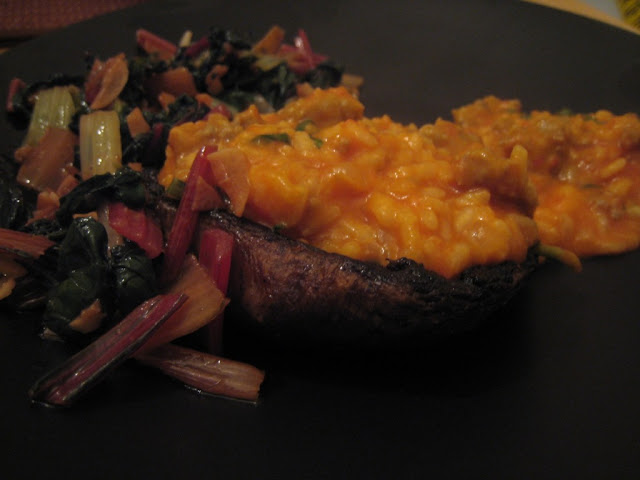
Tomato and Sausage Risotto
Modified from Martha Stewart Everyday Food
In a small saucepan, combine tomatoes (with their juice) and 3 cups water. Bring just to a simmer; keep warm over low heat.
In a medium saucepan, heat oil over medium. Add sausage and onion; season with salt and pepper. Cook, breaking up sausage with a spoon, until sausage is opaque and onion has softened, 3 to 5 minutes.

Add rice; cook, stirring until well coated, 1 to 2 minutes. Add wine; cook, stirring until absorbed, about 1 minute.
Add about 2 cups hot tomato mixture to rice; simmer over medium-low heat, stirring occasionally, until absorbed, 4 to 5 minutes. Continue adding tomato mixture, 1 cup at a time, waiting for one cup to be absorbed before adding the next, stirring occasionally, until rice is creamy and just tender, about 25 minutes total (you may not have to use all the liquid).


Remove pan from heat. Stir in basil, Parmesan, and butter; season with salt and pepper. Why the butter? Because you're "mounting" your sauce. You heard me. It's from the French monter au beurre, meaning "build with butter" and pronounced "mount" by the less classy Americans who heard the phrase. It's the process of adding a cold fat to a hot liquid and getting it to emulsify at temperatures above where it usually breaks down into milk solids, fat, and water. Restaurants tend to do this to develop a more velvety, bodied sauce, which you have probably simply called "delicious", "rich", or "OMG". Also, they tend to put in way too much - websites I scanned just called for 1 tbsp butter per 1/2 cup of sauce, so don't get crazy mopping that stuff up with your bread.
Serve immediately, and sprinkle with additional Parmesan, if desired. For a classy presentation, grill portobello caps and use them as small serving bowls on your plate, as shown above. A recipe follows.
Grilled Portobello Caps
by me
Your average risotto is made by slowly cooking the rice in hot broth as it is stirred, unfolding the starchy web on the outer layer of the rice so that it can dissolve into the cooking liquid. Chicken broth is very commonly used for this. But I was intrigued by the idea of using canned tomatoes instead of broth, just for the variety. It turns out that this is an amazing twist on your average risotto, transforming a meaty, savoury dish into a lighter, more aromatic dish. The meat still finds its way in by way of some Italian sausage, but it's a different backbone that was eye-opening and delicious.

Tomato and Sausage Risotto
Modified from Martha Stewart Everyday Food
- 1 can (28 ounces) diced tomatoes in juice
- 1 tablespoon olive oil
- 3/4 pound sweet or hot Italian sausage, casings removed
- 1 small onion, finely chopped
- Coarse salt and ground pepper
- 1 cup Arborio or Carnaroli rice
- 1/2 cup dry white wine, or dry Vermouth
- 10 leaves basil, chiffonaded
- 1/2 cup grated Parmesan cheese, plus more for serving (optional)
- 2 tablespoons butter
In a small saucepan, combine tomatoes (with their juice) and 3 cups water. Bring just to a simmer; keep warm over low heat.
In a medium saucepan, heat oil over medium. Add sausage and onion; season with salt and pepper. Cook, breaking up sausage with a spoon, until sausage is opaque and onion has softened, 3 to 5 minutes.

Add rice; cook, stirring until well coated, 1 to 2 minutes. Add wine; cook, stirring until absorbed, about 1 minute.
Add about 2 cups hot tomato mixture to rice; simmer over medium-low heat, stirring occasionally, until absorbed, 4 to 5 minutes. Continue adding tomato mixture, 1 cup at a time, waiting for one cup to be absorbed before adding the next, stirring occasionally, until rice is creamy and just tender, about 25 minutes total (you may not have to use all the liquid).
 |
| Here's the process of risotto, armed with a fancy risotto spoon. Observe how the rice swells and the liquid becomes thicker in these time history photos, taken at the 3 minute mark, the 20 minute mark, and the 26 minute mark. |


Remove pan from heat. Stir in basil, Parmesan, and butter; season with salt and pepper. Why the butter? Because you're "mounting" your sauce. You heard me. It's from the French monter au beurre, meaning "build with butter" and pronounced "mount" by the less classy Americans who heard the phrase. It's the process of adding a cold fat to a hot liquid and getting it to emulsify at temperatures above where it usually breaks down into milk solids, fat, and water. Restaurants tend to do this to develop a more velvety, bodied sauce, which you have probably simply called "delicious", "rich", or "OMG". Also, they tend to put in way too much - websites I scanned just called for 1 tbsp butter per 1/2 cup of sauce, so don't get crazy mopping that stuff up with your bread.
 |
| These are the finishing ingredients - they only go in at the very end |
 |
| Now, stand over your dish... and mount it! |
Serve immediately, and sprinkle with additional Parmesan, if desired. For a classy presentation, grill portobello caps and use them as small serving bowls on your plate, as shown above. A recipe follows.
Grilled Portobello Caps
by me
- 2 medium portobello caps
- 1 tsp coarse dijon mustard
- 1/2 tbsp red wine vinegar
- salt and pepper
- 2 tbsp olive oil
Stir together last four ingredients, and brush onto both sides of mushroom caps. Cook on a hot grill for 5-6 minutes per side.
Tuesday, December 25, 2012
Kokkinisto (Greek Braised Red Lamb with Tomatoes)
This year, Christmas Eve was spent cooking, taking pictures, and frantically trying to scribble down a surprise recipe that I would be proud to call the best lamb recipe I have ever made. I think I need to just start following my brother around and taking notes on everything he does. When I showed up yesterday to help make dinner, he was making two boneless legs of lamb into a dish that didn't sound quite my style. So I asked if I could set one aside to do something different. And while I'm rummaging around in my recipe folder for a lamb recipe, he just busts this one out off the top of his head, rivaling the best Greek restaurant lamb dish I've ever tried. After thinking about it for the duration of the cooking process, he finally goes, "it's called kokonisto or something". So we looked it up, and sure enough, there's a dish called kokkinisto, and even without a recipe he basically nailed it. It's a braised meat dish (kokkinisto means "reddened" in Greek, I believe) cooked in tomato, and often with red wine, and just a tiny hint of cinnamon to accentuate the spiced flavors. Usually lamb is used, but I found recipes for beef and chicken on the web as well.
I present the recipe as I will make it moving forward, just adding some red wine and serving over orzo, a rice-shaped pasta that really helps hold the sauce and is a traditional accompaniment in Greek restaurants. But this was excellent on its own, and I devoured every bite, excited to make this again at my house. And you should make it in yours.
 |
| Kokkinisto - braised lamb in a tomato sauce. OMG. |
I present the recipe as I will make it moving forward, just adding some red wine and serving over orzo, a rice-shaped pasta that really helps hold the sauce and is a traditional accompaniment in Greek restaurants. But this was excellent on its own, and I devoured every bite, excited to make this again at my house. And you should make it in yours.
Monday, December 3, 2012
Fettuccine with Pesto and Summer Squash
Okay all, here's a quick and easy recipe I think I came up with a while back, trying to find a use for some zucchini. If you're like me, every summer you end up with too much of the stuff, and you're desperately trying to find a way to use it. And you can only grill so much of it before you want to gag, so you start looking for new and creative ways to give it different flavors. This one uses a pesto and ricotta cheese to give it both a sweet creamy texture as well as that pungent herb taste, and it comes together incredibly fast. If you got really crazy you could make your own pasta or pesto, but for this one I'm using store bought ingredients (although they were both fresh, not dried or canned). This dish is arguably similar to this one which I posted last year, but with a lot more flavor going on, and a few more ingredients. It is also distinctly non-vegan, for those of you who live by that code, whereas the other one might have been.
 |
| Always on the lookout for good uses of squash - this one hit the mark |
Fettuccine with Pesto and Summer Squash
- 1 pint (2 cups) fresh zucchini or other summer squash
- 2 tomatoes
- 1 small onion, diced
- 2 cloves garlic, minced
- 2 tbsp olive oil
- 1/4 pound fettuccine, dried, one 1/2 pound container of fresh fettuccine from the refrigerated section, or equivalent volume homemade pasta
- 4 ounces pesto
- 1/4 cup ricotta cheese
- salt and pepper to taste
Peel your tomatoes by blanching in a large pot of hot water (check here for detailed instructions). Reserve the hot water for boiling your pasta - you can use that water again, making this more time efficient. After shocking in ice water, coarsely chop tomatoes and set aside. Chop the zucchini into bite-sized pieces, no larger than 3/4" to a side. If using dried pasta, begin to boil now and follow package instructions to cook until just shy of al dente - maybe 30 seconds short of done. If using fresh, read on.
 |
| Prep your ingredients - I used local mini squash, which have less bitter seeds |
Heat olive oil in a large skillet over medium heat. Add the zucchini and cook until starting to brown, then shake / flip and cook other side. When you flip the zucchini, add the onion, and stir around to saute lightly. Saute the garlic for just a few seconds. If using fresh pasta, add to pot of boiling water now, and cook for the 60-90 seconds recommended by the package, or whatever you feel comfortable with for homemade.
Back in the skillet, lower heat to medium low, add the tomatoes with any juice that may have accumulated, and cook for 30 seconds. Add the pesto and stir to combine, and keep warm. Drain cooked pasta, reserving up to 1/4 cup of the cooking water, and add pasta to the sauce. Stir to combine, adding water a little at a time as needed to reach the consistency you like. The starchy water will help partially thicken the dish while creating more of a sauce, as well as help finish the pasta (which you cooked to NOT QUITE al dente, right?) by cooking it in this sauce.
 |
| Toss the sauteed vegetables with the pesto and partially cooked tomatoes. Don't keep the heat on too high at this point or you'll lose some of the subtlety |
To serve, plate pasta into 2-3 servings, and garnish each with 2 tbsp of ricotta cheese. If you want to get crazy, add a chiffonade of basil threads (see Wikipedia for a nice picture of this). Eat it, love it, feel good about yourself for eating healthy.

Subscribe to:
Posts (Atom)
LinkWithin
